The EU Sport Forum 2026, held in Paphos on 15 to 16 April, closed with five themes on the table, and the long-awaited ECORYS study on the European Sport Model — commissioned by DG EAC and now publicly available — has entered the policy discussion alongside it. Read together, these two artefacts set the EU sport funding agenda that federations, Erasmus+ Sport applicants, and innovation leaders will work inside through 2027 and into the next Multiannual Financial Framework (MFF). The most quietly consequential shift was mental health moving from a recurring conference topic to a structural pillar of the EU Work Plan for Sport 2024 to 2027, with a clear funding pathway behind it.
How the EU Sport Forum became the agenda-setter for the next decade
The EU Sport Forum is the annual gathering convened by the European Commission's Directorate-General for Education, Youth, Sport and Culture (DG EAC). DG EAC is the Commission service responsible for EU policy on education, youth, sport, and culture, and it is the policy owner of EU sport cooperation. The Forum brings together the Commission, the rotating Council Presidency, sport movement representatives, athlete bodies, and civil society to test the policy direction that will shape upcoming Council Conclusions, Erasmus+ Sport calls, and the next EU Work Plan for Sport.
The 2026 edition was delivered in cooperation with the Cyprus Ministry of Education, Sport and Youth. Two opening interventions framed the two days. Paola Ottomano, head of the Sport Unit at DG EAC, opened the policy strand. Luciano Di Fonzo, representing the European Education and Culture Executive Agency (EACEA, the Commission agency that manages Erasmus+ Sport calls and grants), set out the operational and funding context. The combination matters: the Sport Unit defines what is fundable in principle, EACEA defines what is fundable in practice through call texts, evaluation criteria, and award decisions.
Five themes structured the agenda: women's sport, talent rewards, lifelong wellbeing, the future of European Week of Sport, and mental health. Each theme is already named in the EU Work Plan for Sport 2024 to 2027, the Council document that sets EU-level sport priorities. The Forum's role is to translate Work Plan headings into operational signals that the next round of calls can absorb.
What the ECORYS study and the Forum themes actually say
The ECORYS study on the European Sport Model was commissioned by DG EAC and conducted by ECORYS, an international research and consultancy firm regularly contracted by EU institutions to deliver evidence studies. The European Sport Model is the Commission's term for the governance architecture of European sport, characterised by open competitions, promotion and relegation, the pyramid structure linking grassroots to elite levels, and solidarity mechanisms that redistribute resources across the system. The EOC EU Office, which represents national Olympic committees in Brussels, has confirmed publication and shared the Commission's framing.
Mental health sits at the intersection of the lifelong wellbeing theme and the talent rewards theme. The 2026 Forum did not introduce mental health as a new topic; it changed its location in the policy architecture. Where previous editions referenced mental health as a horizontal concern, the 2026 framing positions it as a discrete, fundable area inside the Work Plan period, with player associations, federations, and athlete bodies all using consistent language around it.
The ECORYS study, in parallel, gives the Commission, the CULT Committee of the European Parliament, and Member States a shared reference text on the European Sport Model. The study itself is descriptive and analytical of governance arrangements; it is not a regulatory instrument. Its weight comes from being a Commission-commissioned evidence base that can be cited in subsequent Council Conclusions and call narratives.
What changes for Erasmus+ Sport applicants
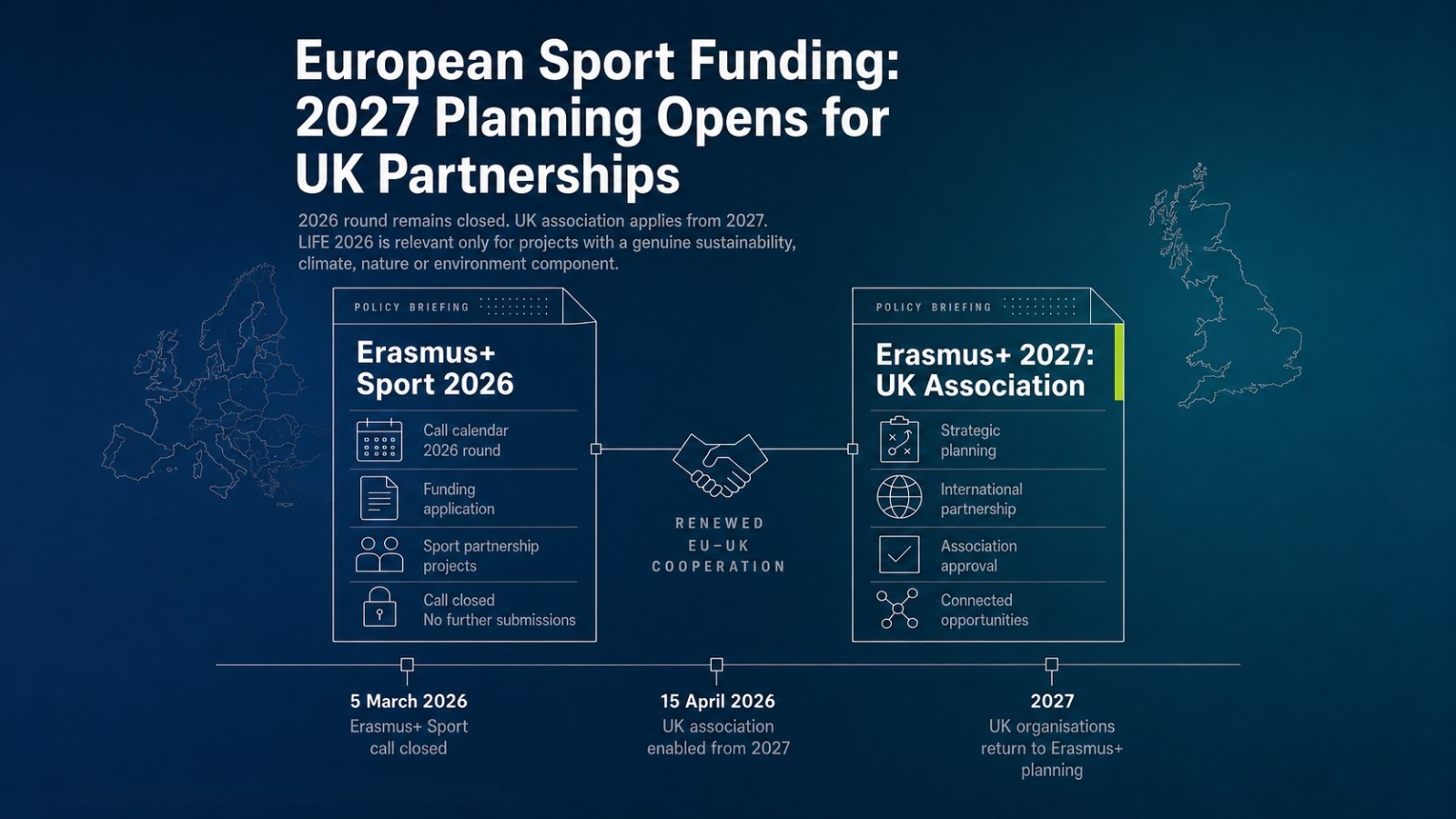
For organisations preparing Erasmus+ Sport proposals for 2026 and 2027 calls, two practical shifts follow from the Forum and the ECORYS release.
First, mental health can now be referenced as a structural pillar rather than as a soft theme. The phrasing in proposal narratives can shift from "we will also consider mental wellbeing" to "the project addresses mental health as a priority area named in the EU Work Plan for Sport 2024 to 2027." That is a stronger anchor for evaluators because it ties the proposal to a Council-adopted document rather than to a generalised wellbeing argument.
Second, ECORYS gives applicants a Commission-owned source to cite when arguing for governance, solidarity, or grassroots-to-elite continuity dimensions of their projects. Previously, applicants frequently cited national federation positions or sport movement statements, which evaluators may treat as advocacy. A Commission-commissioned study sits in a different category as a reference. This is a practical drafting point rather than a guarantee of evaluation outcomes.
What changes for national federations and Olympic committees
For national federations and national Olympic committees, the Forum signals continuity rather than rupture. The five themes are recognisable from the Work Plan; the European Sport Model is reaffirmed as the Commission's reference framework. The substantive question is operational alignment: federations that adapt their internal strategy documents to use Work Plan language (women's sport, talent rewards, lifelong wellbeing, mental health) will find their alignment with EU calls clearer.
What changes for sport-tech and innovation organisations
For sport-tech firms, innovation leaders, and applied research organisations, three openings are visible in the Forum's themes.
The mental health theme creates demand for measurement, screening, and longitudinal monitoring tools that respect athlete data rights and clinical boundaries. The lifelong wellbeing theme creates demand for participation models that span age groups, including ageing populations. The future of European Week of Sport theme creates demand for engagement formats that move beyond one-week visibility campaigns toward year-round behaviour change. None of these themes is new in isolation. What is new is their consolidation into a single, Commission-led agenda with an evidence base behind it.
Outlook: scenarios, not predictions
The next inflection points in the EU sport funding architecture are the next round of Erasmus+ Sport calls under the current programme, the Council Conclusions that will follow this Forum cycle, and the ongoing negotiation of the next MFF. None of these are settled. What can be observed is the shape of the conversation.
The honest reading of W18 is that the Commission has now placed two artefacts on the table — a thematic agenda from the Forum and an evidence base from the ECORYS study — and the next year will be spent translating both into call texts and Council Conclusions. Federations, Erasmus+ Sport applicants, and innovation leaders who read both documents in their own framing will have a sharper sense of what the next funding cycle is asking for.
Sources
- European Commission, DG EAC — EU Sport Forum 2026
- EOC EU Office — European Commission study on the European Sport Model
- Council of the EU — EU Work Plan for Sport 2024 to 2027
- EACEA — Erasmus+ Sport programme management