An IOC eligibility policy revision published in April 2026 has been followed, within roughly two weeks, by formal moves at World Athletics, World Aquatics, World Triathlon, and a public alignment statement from the Comité Olímpico de Portugal. The pattern is observable in the public record. It warrants careful, source-bound analysis now because the sequence concentrates several distinct governance threads, including a separate Russia and Belarus participation question, into a single fortnight of federation-level decision making.
How federation eligibility policy autonomy reaches the IOC level
International Federations (IFs) are the governing bodies for individual Olympic sports, recognised by the International Olympic Committee (IOC). The IOC sets the overarching framework for the Olympic Movement; IFs hold autonomy over their own eligibility rules within that framework. Until recently, eligibility for the women's category in elite competition had been handled federation by federation, with significant variation between them.
The IOC's revised framework for the women's category, published in April 2026 and operationalised through SRY-gene screening, replaces the federation-by-federation default with a common reference point. An OHCHR press release records a UN human rights expert engaging publicly with the framework. That statement is referenced here strictly as a public institutional position; the analysis below does not extend it.
Within the same window, four IFs and one National Olympic Committee (NOC) have entered the public record with related but distinct decisions. The Comité Olímpico de Portugal pledged, in a statement on 21 April 2026, to implement the IOC framework with what it described as rigour and proportionality, while respecting confidentiality and athlete dignity.
What the World Athletics Council Tokyo update signals
The World Athletics Council, meeting in Tokyo, received an implementation update on SRY-gene testing, with more than 95% of testing reported as complete. The same Council session also approved competition-format adjustments outside the eligibility question: a fixed running order of man-woman-man-woman for the 4x100m mixed relay in World Athletics Series events, and a new format for the indoor 400m, with the number of athletes per heat reduced from six to four and a potential pilot at the 2026 World Athletics Indoor Championships.
Three observations follow from the published Council communication, each tied directly to that source:
- The implementation pace on SRY testing is well advanced rather than at the planning stage, which signals an operational rollout already in motion.
- Eligibility-related and event-format changes were processed in the same Council session, indicating that World Athletics is treating its 2026 governance agenda as a consolidated package.
- The published wording locates the policy update inside the existing eligibility regulations rather than introducing a separate instrument, which keeps the change inside an established regulatory architecture.
What this does not tell us, and what the published record does not extend to, is the operational specifics of how testing is administered. We do not analyse those specifics here.
Russia and Belarus reinstatement: a separate but connected policy autonomy thread
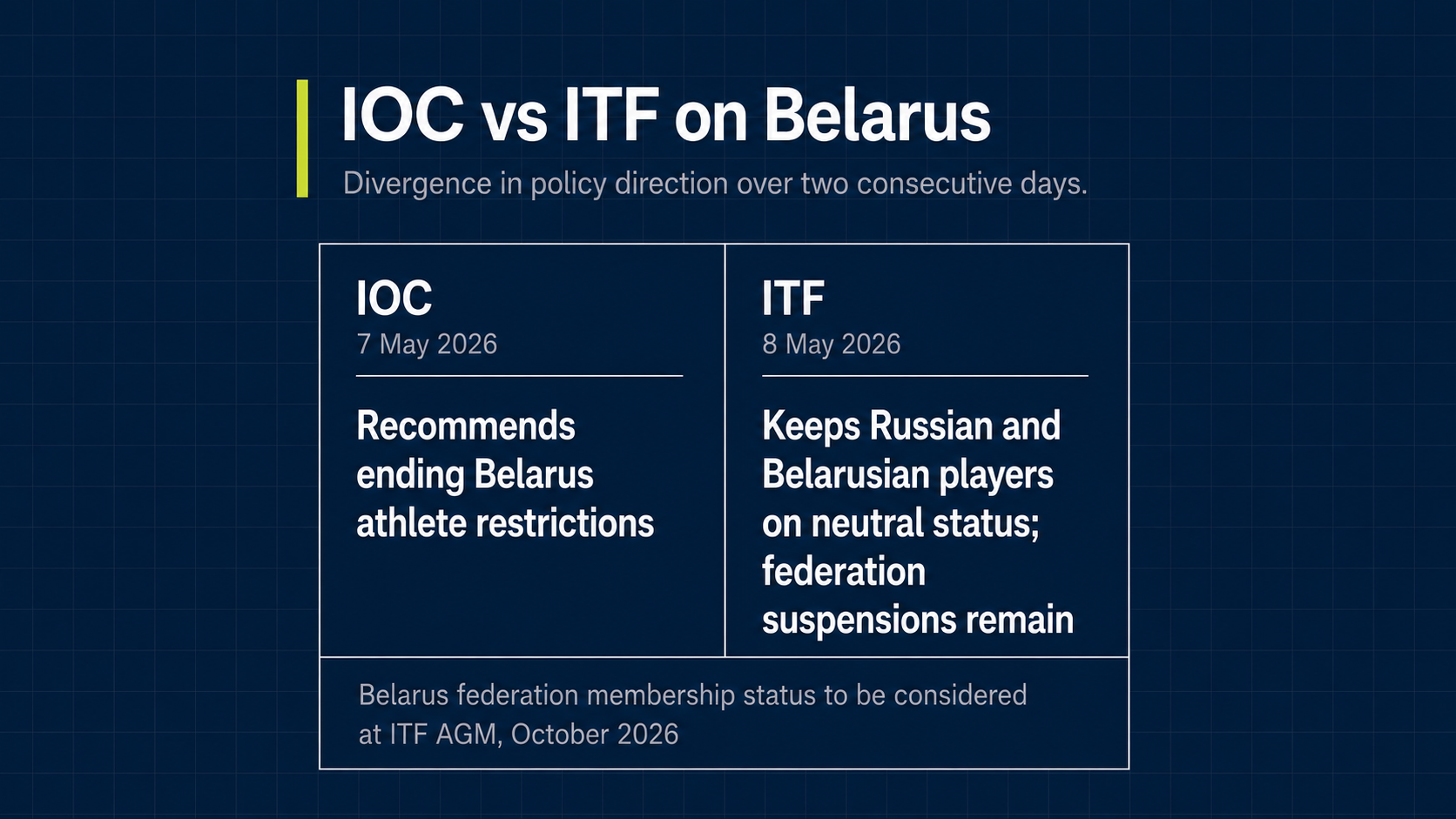
Two of the federation decisions in the same fortnight concern Russian and Belarusian athlete participation rather than the women's-category framework. We treat these as a separate but connected thread.
The World Aquatics Bureau, with effect from 13 April 2026, amended its Guidelines on Athlete Participation During Periods of Political Conflict. Senior Russian and Belarusian athletes recover full membership rights under Article 6 of the World Aquatics Constitution, including voting at Congress and competition under their flags and anthems, conditional on at least four successive anti-doping controls and background checks by the Aquatics Integrity Unit (AQIU), the federation's independent integrity body.
The World Triathlon Executive Board, in its April 2026 meeting, addressed parallel reinstatement pathways for Russian athletes within its development plans framework.
These two decisions sit in the same governance cascade as the eligibility framework, in the sense that both concern the exercise of federation-level policy autonomy following an IOC signal cycle. They are not part of the SRY-screening eligibility question. Collapsing the two threads would misrepresent each. We note them here so the cascade is described in full, and stop there.
What NOC alignment means for the cascade
National Olympic Committees coordinate Olympic participation at country level and translate IOC frameworks into national implementation. The Comité Olímpico de Portugal's 21 April 2026 statement expresses alignment with the IOC framework and a commitment to confidentiality and athlete dignity in implementation.
One NOC alignment statement is a single data point. It indicates that public NOC-level positioning on the framework has begun, and it confirms that at least one NOC is treating implementation, rather than the framework itself, as the live question. We do not extrapolate from one NOC to others.
What is observable, and what is not, as May 2026 begins
The observable pattern, on the published record:
- One IOC framework revision, April 2026.
- One UN expert engagement via OHCHR press release.
- One IF Council update on SRY testing implementation, with associated event-format decisions (World Athletics, Tokyo).
- One IF decision on Russia and Belarus participation, effective 13 April 2026 (World Aquatics).
- One IF Executive Board engagement on parallel Russian-athlete pathways (World Triathlon, April 2026).
- One NOC alignment statement, 21 April 2026 (COP Portugal).
What is not observable from this record is how other IFs that have not yet published a position will sequence their own decisions, how individual NOCs will translate the framework into national implementation, or how each federation's chosen language will hold up under its own internal review processes. Those are open questions, and the honest position is to treat them as open.
For sport organisation executives, federation strategy leads and governance professionals, the practical near-term tracking points are: which IFs publish next on eligibility; whether further NOC alignment statements appear in May; and how the Russia and Belarus thread evolves separately at federations that have not yet acted on it. The cascade is observable. The trajectory is not.
Sources
- IOC framework for the women's category, April 2026
- OHCHR press release on the IOC framework
- World Athletics Council, Tokyo — Growth and Innovation Agenda
- World Aquatics Bureau — Athlete Participation Guidelines amendment, 13 April 2026
- World Triathlon Executive Board — 2026 development plans
- Comité Olímpico de Portugal statement, 21 April 2026