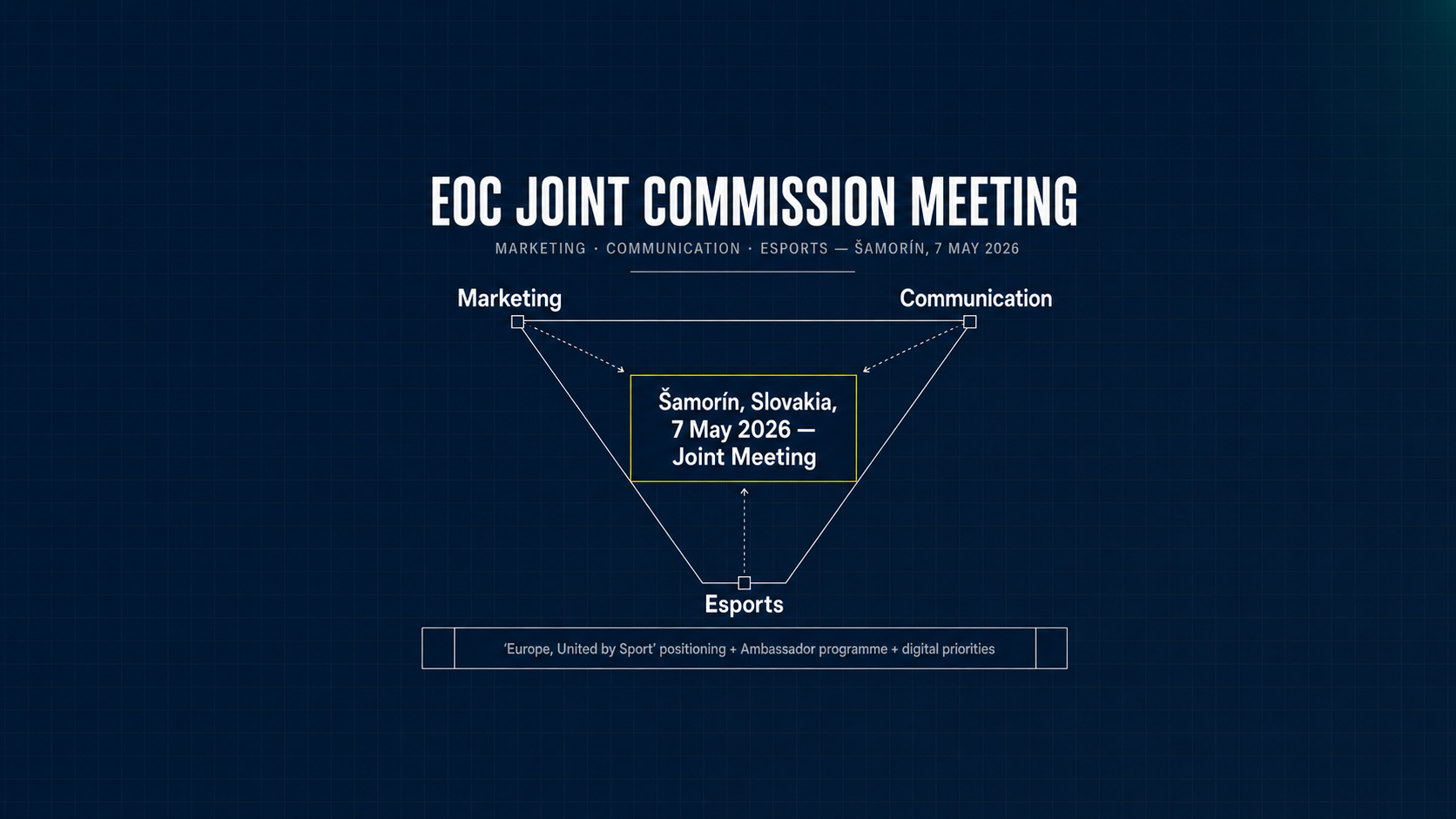
The European Olympic Committees convened its Marketing, Communication and Esports Commissions for a joint meeting in Šamorín, Slovakia on 7 May 2026, per the EOC primary release. The joint format is the structural signal: these portfolios are normally structured as separate commissions, even where their work overlaps, and the EOC is now coordinating them directly on the implementation of the "Europe, United by Sport" positioning, brand strategy and digital agendas.
What each commission does
The EOC's commission architecture distributes its substantive workstreams across permanent expert bodies, each with a defined remit and an annual workplan. Three of those commissions sit at the intersection of EOC commercial, brand and digital portfolios. For the purpose of this analysis, these commissions can be read as covering commercial positioning, institutional communication and digital/esports engagement; the specific 7 May agenda items confirmed by the EOC primary release are summarised in the next section.
Marketing Commission (Chair: Franjo Bobinac, EOC Executive Committee member). Commercial positioning for EOC-owned properties, sponsorship and partnership strategy across the European Olympic Movement, and revenue-side coordination with NOCs.
Communication Commission (Chair: Danka Hrbeková, EOC Executive Committee member). Narrative discipline for European Olympic Movement positioning, brand positioning across EOC properties, digital channel strategy, and stakeholder communication.
Esports Commission (Chair: Emma Terho, EOC Executive Committee member). The Esports Commission's remit covers the relationship between esports and European Olympic Movement institutions, engagement with the IOC's Olympic Esports Games framework, and integration of esports into the EOC's strategic positioning. It is a comparatively recent addition to the EOC commission architecture, established as the European Olympic Movement formalised its esports engagement workstream.
What the 7 May meeting actually discussed
Per the EOC primary release, a central focus of the joint meeting was the EOC's marketing strategy and the implementation of the "Europe, United by Sport" positioning, with discussions centring on strengthening the EOC's institutional identity and enhancing the visibility of European sport through coordinated initiatives.
A proposed Ambassador programme was positively received by the joint commissions as a key tool to engage athletes across Europe and to further promote EOC activities and values.
The meeting also reviewed the EOC digital ecosystem and communication performance, including the RFP for a new digital content production and channel management agency. The commissions also discussed engagement with European Federations, the long-term positioning of the European Games and other EOC events, the ongoing European Broadcasting Union agreement, and sponsorship and branding considerations for NOCs.
The Esports Commission's contribution to the joint meeting was framed by Chair Emma Terho around what the EOC release describes as "a strong and innovative digital approach," platform development, and exploring new formats to connect with future generations.
The outcomes of the meeting will inform ongoing work and will be further developed in the lead-up to the next EOC Executive Committee meeting in Budapest on 11 June 2026, per the EOC primary release.
Why the joint format is the structural signal
Convening all three in a single joint meeting represents a coordination intensification. For European sport-business stakeholders, three reads emerge.
Commercial and digital agendas are being treated as integrated. Marketing (sponsorship and "Europe, United by Sport" implementation), Communication (brand and narrative), and Esports (digital category) increasingly share substantive overlap. A sponsorship partner of EOC-owned properties is also a brand-narrative partner and may increasingly be an esports or digital-platform partner. Treating these as separate workplans risks producing inconsistent positioning across commercial files; the joint format closes that gap.
Esports is being connected to communication, audience development and commercial positioning. This is the more consequential read. Esports has often been handled as a distinct strategic file within Olympic institutions — a question of how esports counts as Olympic-eligible, and how the IOC's Olympic Esports Games framework lands at European NOC level. The joint commission format suggests the EOC is connecting esports more directly with communication, audience development and commercial positioning, rather than reading it as a standalone digital file.
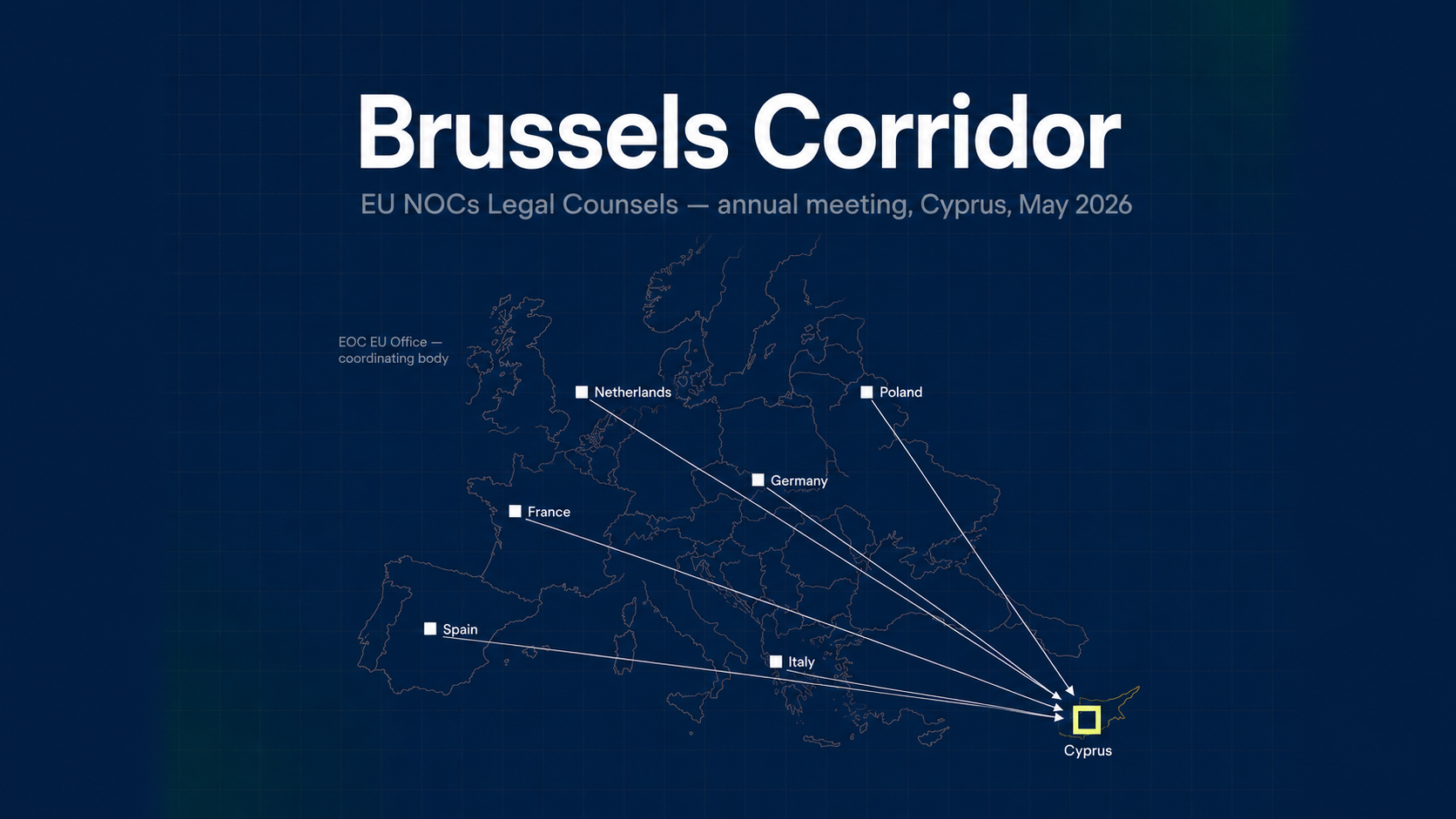
Šamorín, Slovakia as host venue. The choice reflects the EOC's pattern of rotating Member State NOC venues for commission meetings. The Slovak Olympic and Sport Committee is an active EOC member. The pattern of rotating venues across Member State NOCs sits alongside other European Olympic Movement institutional rotation files — for example, the EU NOCs Legal Counsels annual meeting hosted in Cyprus in the same week (covered separately in W21).
The IOC Olympic Esports Games file is in active reshuffle
The Esports Commission's engagement with the IOC Olympic Esports Games framework sits against a moving institutional backdrop. The IOC announced on 12 July 2024 that the inaugural Olympic Esports Games would be hosted by Saudi Arabia in a 12-year partnership with the Saudi National Olympic Committee, with the first edition subsequently confirmed in February 2025 for Riyadh in 2027. On 30 October 2025 the IOC and the Saudi Olympic and Paralympic Committee mutually agreed to end their cooperation on the Olympic Esports Games.
Early-May 2026 industry reporting (GamesBids, Esports News UK, Inven Global and other Tier 2 outlets) subsequently indicated that the dedicated IOC Esports Commission structure had been put on hold or disbanded under IOC President Kirsty Coventry's broader restructuring. As of the date of the EOC joint meeting (7 May 2026), the IOC has not yet publicly confirmed a replacement host or revised launch model for the Olympic Esports Games. That makes the joint format relevant to watch during the rebuild window: EOC Esports Commission discussions on European positioning towards the Olympic Esports Games are no longer reading a settled framework — they are reading a framework currently being rebuilt at IOC level.
What this means for European sport-business stakeholders
Three practical reads emerge.
Sponsors and commercial partners. Sponsors of EOC properties, NOC sponsors who also engage at EOC level, and commercial partners across federation and league boundaries should expect more integrated positioning from EOC commissions, anchored on the "Europe, United by Sport" implementation. Commercial-partner-facing communications will increasingly reflect cross-commission coordination.
Digital and esports stakeholders. Esports federations, publishers, esports-tournament organisers and platform partners engaging with European Olympic Movement bodies should treat the Esports Commission as connected to the Marketing and Communication agendas rather than as a standalone digital file. Sector-wide cluster activity over the same window — for example, the GSIC Summit APAC 2026 in Singapore on 21 to 22 May (covered separately in W21) — sits in the broader sport-tech and commercial cluster map within which EOC esports positioning is being read.
NOC-level commercial partners. Member State NOC commercial partners benefit from the increased coordination because EOC-level commission alignment reduces the risk of conflicting commercial positioning between EOC properties and NOC commercial campaigns.
What is uncertain
The 7 May joint meeting readout published by the EOC is high-level — it confirms the agenda anchors ("Europe, United by Sport" implementation, the Ambassador programme, the RFP for a new digital content and channel management agency, the EBU agreement, European Federations and European Games positioning, NOC sponsorship and branding considerations, and the Esports Commission's digital direction) and the chairs' framing, but does not publish a detailed workplan output. Commission meeting outputs typically take the form of workplan updates that feed into the EOC Executive Committee.
The Esports Commission's specific positioning on the Olympic Esports Games rebuild is one of the more consequential open questions. The IOC's choice of new host and the timeline for any revised launch model will shape what European-level esports engagement looks like through the LA 2028 cycle.
Forward look
Three watch items:
- EOC Executive Committee meeting in Budapest on 11 June 2026 — the next institutional waypoint where joint-meeting outputs feed into the broader EOC workstream
- EOC "Europe, United by Sport" public-facing implementation milestones — the proximate driver for cross-commission coordination over the next twelve months
- IOC Olympic Esports Games host and launch model announcement under the Coventry presidency restructuring — the open file that the EOC Esports Commission's positioning is reading against
The reasonable read of 7 May is that the EOC is using the joint format to align its commercial, brand and digital files behind the "Europe, United by Sport" implementation and a proposed Ambassador programme, with the additional context that the Olympic Esports Games framework is itself in active reshuffle at IOC level. The reasonable editorial read is to track the integration patterns rather than the meetings themselves.
Sources
- European Olympic Committees — EOC Marketing, Communication and Esports Commissions hold joint meeting in Šamorín (May 2026)
- IOC primary — IOC announces Olympic Esports Games to be hosted in the Kingdom of Saudi Arabia (12 July 2024)
- IOC primary — Inaugural Olympic Esports Games to be held in Riyadh in 2027 (11 February 2025)
- IOC and Saudi Olympic and Paralympic Committee joint statement on mutual end of cooperation on the Olympic Esports Games (30 October 2025)
- Industry reporting on the early-May 2026 IOC Esports Commission restructuring (GamesBids, Esports News UK, Inven Global, Inside Sport India, Ministry of Sport)