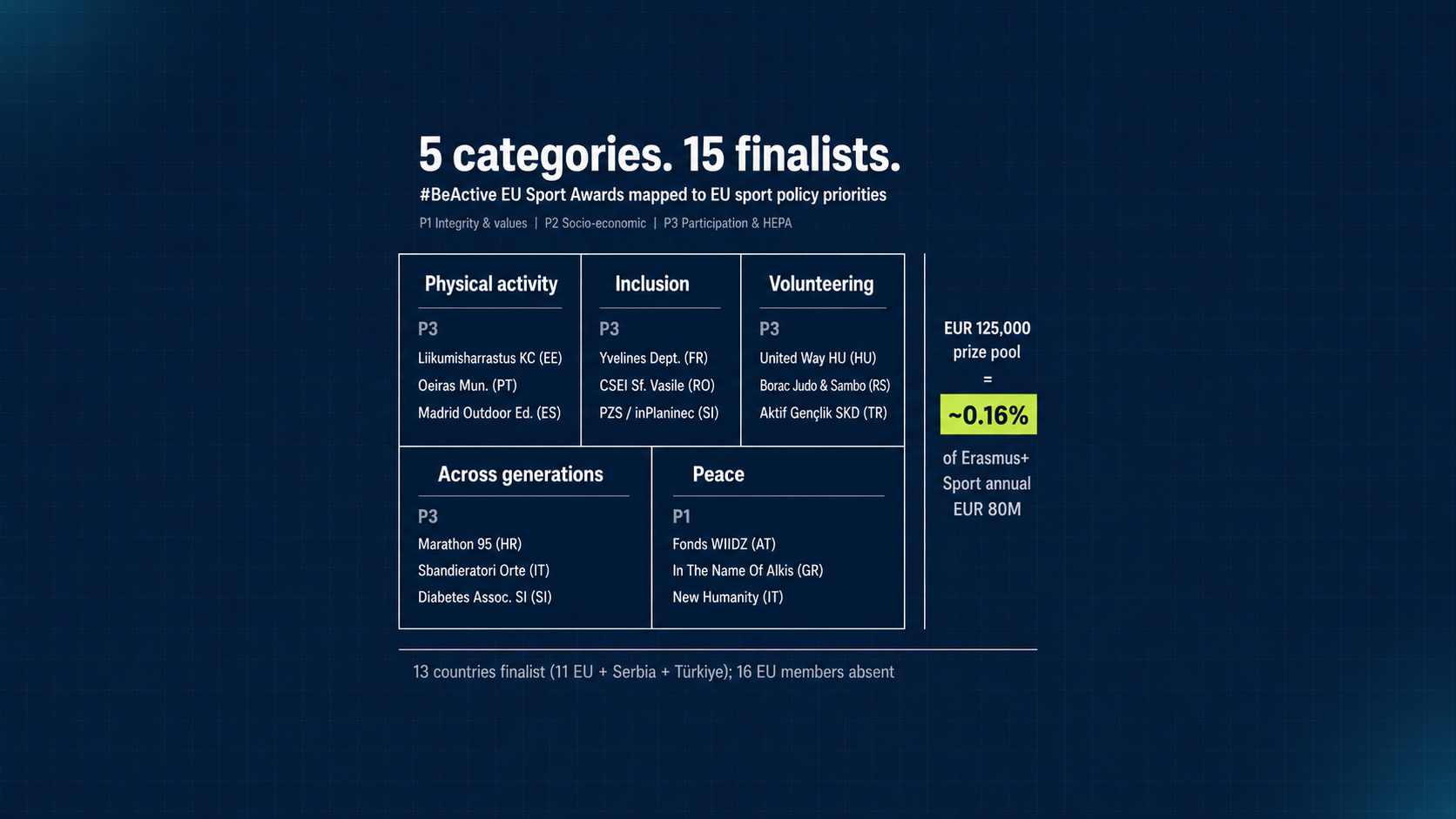
The European Commission's Directorate-General for Education, Youth, Sport and Culture (DG EAC) announced on 8 April 2026 the fifteen first-ever finalists of the consolidated #BeActive EU Sport Awards, drawn from 279 submitted projects across the 2025-2026 application cycle (applications closed 24 September 2025). The five-category structure carries a total prize pool of EUR 125,000, with EUR 15,000 for the winner in each of the five categories and EUR 5,000 for each of the two further finalist organisations per category. The ceremony at which winners will be announced is scheduled for 23 June 2026 in Brussels.
The reasonable read is that the substantive signal is not the funding scale (which is, accurately, small by EU programme standards) but the project pattern the European Commission is amplifying through its 2025-2026 recognition cycle. Reading the finalist list at organisation-name level only would miss the cycle's actual content. The cycle is the first one in which the previously separate #BeActive Awards (2015-2024) and #BeInclusive EU Sport Awards (2018-2024) programmes operate inside one consolidated five-category framework, and it is the first cycle whose category mapping can be fully tracked against the EU Work Plan for Sport 2024-2027 three-priority architecture.
What the fifteen finalist projects actually do
Physical Activity category:
- Sihtasutus Liikumisharrastuse Kompetentsikeskus (Estonia): the Ball Boxes project — installing free public sports-equipment boxes at public sports facilities to enable spontaneous physical activity
- Município de Oeiras (Portugal): the Fit Senior Programme — an older-adult exercise-adherence programme delivered by the municipality
- Asociación Madrid Outdoor Education (Spain): a solidarity-based skate school providing equity-based skateboarding instruction in Madrid
Inclusion category:
- Département des Yvelines (France): the Yvelines Parasport programme — disability awareness and parasport pathways at département level
- Centrul Şcolar pentru Educaţie Incluzivă "Sf. Vasile" Craiova (Romania): Breaking Barriers Through MOVEment — rights-based physical activity for children with disabilities
- Planinska Zveza Slovenije (Slovenia): inPlaninec — adaptive mountaineering for people with disabilities, run by the Slovenian Alpine Association
Volunteering category:
- United Way Magyarország (Hungary): the Flow & Learn Program — sport-in-education volunteering at school level
- Judo and Sambo Club Borac (Serbia): the Borac Active Program — combining elite combat sports with deep community service
- Aktif Gençlik ve Spor Kulübü Derneği (Türkiye): a Healthy Lifestyle and Exercise Program targeting women over 50
Across Generations category:
- Trkacki Klub "Marathon 95" Varaždin (Croatia): the Drava Cross League — intergenerational running league across the Drava river region
- Gruppo Sbandieratori delle Sette Contrade di Orte (Italy): Fostering Legacy Across Generations (FLAG) — combining Italian flag-bearing tradition with intergenerational movement
- Zveza Društev Diabetikov Slovenije (Slovenia): #DarujemKilometre — diabetes prevention and awareness through accumulated kilometres of physical activity
Peace category:
- Fonds Wiener Institut für Internationalen Dialog und Zusammenarbeit (VIDC) (Austria): Sport Zajedno — Western Balkans reconciliation through sport
- In The Name Of Alkis (Greece): the UNITE19 project — connecting communities through sport against football-related hate violence (see context below)
- Associazione Internazionale New Humanity (Italy): Run4Unity — teenagers as active citizens through a global-citizen running initiative
Read as a list, the recognition pattern is concrete and specific: the Commission is amplifying spontaneous-use public infrastructure (Estonia), older-adult adherence (Portugal), equity-based skill instruction (Spain), parasport pathways (France), rights-based PA for children with disabilities (Romania), adaptive mountain access (Slovenia), school-integrated movement (Hungary), combat-sport community service (Serbia), women-over-50 health (Türkiye), intergenerational community running (Croatia), tradition-plus-movement (Italy), diabetes prevention via accumulated movement (Slovenia), Western Balkans reconciliation through sport (Austria), football-violence response through community sport (Greece), and teenager global-citizenship through running (Italy).
That set is the actual policy signal the Commission is publishing. Stripped to organisation names alone, the list loses its information value.
The Peace category's most substantive case: In The Name Of Alkis (Greece)
The Greek Peace-category finalist requires specific context. In The Name Of Alkis is the civil-society organisation founded after the murder of Alkis Kambanos, a 19-year-old Aris Thessaloniki football fan killed in Thessaloniki on 1 February 2022 by a group of attackers associated with PAOK Thessaloniki's rival fan environment. The criminal case concluded in July 2023 with the conviction of twelve defendants and the imposition of seven life sentences alongside additional long custodial terms. The case became a turning point in Greek football-violence governance and informs the UNITE19 project that In The Name Of Alkis is delivering. (The project's name is the EC-listed designation; the organisation's own published materials do not publicly elaborate the naming, so any reading of the "19" as a reference to Alkis's age at death is plausible-editorial rather than primary-source confirmed.)
This is the most operationally specific case in the Peace category, and it shifts the category from an abstract "sport-for-peace" framing to a documented response to specific fan-violence facts. For European sport-governance observers, that specificity is the analytical content the recognition is publishing.
The Peace category is not new in 2025 — it is carried over from #BeInclusive
A widely circulating reading of the 2025-2026 cycle is that the Peace category is a wholly new 2025 addition to the EU sport recognition architecture. That reading is partly incorrect on the primary-source evidence. #BeActive Awards (2015-2024), the physical-activity-focused predecessor programme, did not include a Peace category. #BeInclusive EU Sport Awards (2018-2024), the social-inclusion-focused parallel programme, did include a "Sport for Peace" category in its 2024 edition, alongside "Breaking Barriers" and "Sport for Equal Opportunities". The 2025-2026 consolidated #BeActive EU Sport Awards therefore carries the Peace category over from #BeInclusive into the unified five-category framework alongside Physical Activity (from #BeActive lineage), Across Generations (added to #BeActive in 2022 and carried over), Inclusion (consolidated from #BeInclusive) and Volunteering (the substantively new dimension in the consolidated framework).
The structural signal is therefore not "Commission adds Peace category in 2025" — it is "Commission consolidates two previously separate recognition programmes (#BeActive + #BeInclusive) into a single five-category framework, preserving the existing Peace category from #BeInclusive while integrating it into a wider thematic architecture". That consolidation is the policy change worth tracking.
How the five categories map to the EU Work Plan for Sport 2024-2027
The Commission's published sport-policy framework against which the recognition architecture maps is the EU Work Plan for Sport 2024-2027, established via Council Resolution adopted on 23 May 2024 (Official Journal C/2024/3527 of 3 June 2024), covering the period 1 July 2024 to 31 December 2027. The Work Plan establishes three priorities:
- Priority 1: Protecting the integrity and values in sport
- Priority 2: Socio-economic and environmental dimensions of sport
- Priority 3: Promotion of participation in sport and health-enhancing physical activity
The 2025-2026 #BeActive EU Sport Awards five-category structure maps cleanly to these three priorities:
| Category | Maps to Work Plan Priority |
|---|---|
| Physical Activity | Priority 3 (participation + HEPA) |
| Across Generations | Priority 3 (participation across life stages) |
| Inclusion | Priority 2 (socio-economic dimension) |
| Volunteering | Priority 2 (socio-economic dimension) |
| Peace | Priority 1 (values protection) |
That mapping is what makes the recognition architecture more than ceremonial. The Commission is using the awards cycle as a published illustration of the active sport-policy priorities. For European sport organisations and Erasmus+ Sport applicants, the implication is that proposals aligning to one of these five published category dimensions sit inside the active policy framework, not adjacent to it.
The funding scale is small; the structural visibility is the value
The total #BeActive EU Sport Awards prize pool is EUR 125,000, distributed as EUR 15,000 to each category winner and EUR 5,000 to each of the two further finalist organisations per category. For benchmarking: Erasmus+ Sport distributes approximately EUR 80 million annually at the EU level (the 2024 selection round distributed approximately EUR 54 million across 302 projects; the 2025 call published a budget of approximately EUR 76 million). The #BeActive Awards pool therefore represents approximately 0.16 per cent of Erasmus+ Sport annual distribution, well under one quarter of one per cent.
The point is not that EUR 125,000 is operationally meaningful funding for the recipients (it is real money for grassroots organisations but small at programme scale). The point is that the EUR 125,000 buys the Commission a published, sourced, dateable five-category map of what DG EAC reads as best-practice operational delivery against the EU Work Plan for Sport 2024-2027 priorities. Small cash, structural visibility is the operational read.
Geographic spread and where the finalists are not
The fifteen finalists span thirteen countries: Austria, Croatia, Estonia, France, Greece, Hungary, Italy (twice), Portugal, Romania, Serbia, Slovenia (twice), Spain and Türkiye. Eleven of the thirteen are EU member states; Serbia and Türkiye are Erasmus+ Programme Countries with sport-application access. Slovenia is the only country producing two finalists; the remaining twelve countries produce one each.
The geographic distribution carries its own policy reading. Sixteen EU member states have no finalist in this cycle: Belgium, Bulgaria, Cyprus, Czechia, Denmark, Finland, Germany, Ireland, Latvia, Lithuania, Luxembourg, Malta, Netherlands, Poland, Slovakia and Sweden. The pattern is recognisable: a strong Central and Eastern European, Mediterranean, and Western Balkans cluster of recognised projects, with the Nordic and Western European member states absent from the finalist list for this cycle. That absence is unlikely to be coincidence at a fifteen-out-of-fifteen reading; it suggests either that Nordic and Western European grassroots organisations did not apply at scale (these countries typically run sport-recognition through national mechanisms with greater funding scale), or that the jury actively prioritised geographic balance toward smaller-budget member-state ecosystems, or some combination of both. For Erasmus+ Sport and #BeActive applicants in the absent EU markets, the pattern is itself a watch item: a Nordic or German finalist in the 2026-2027 cycle would be a meaningful shift.
What this cycle does and does not tell us about the 2026-2027 application window
The 2026-2027 application window has not been publicly opened on the EC programme page; the page was last updated 11 May 2026 and contains no forward-looking application dates as of this writing. The programme architecture established in the 2025-2026 cycle (five categories, EUR 125,000 prize pool, mapped to the EU Work Plan for Sport 2024-2027) is the publicly observable basis for any 2026-2027 cycle that follows.
The 23 June 2026 ceremony itself is a standalone awards gala, not co-located with the EU Sport Forum 2026, which DG EAC held separately in Paphos, Cyprus on 15-16 April 2026. The 23 June Brussels event is therefore a single-event amplification window for the consolidated awards programme, not a combined recognition-plus-policy-dialogue moment.
What is uncertain
The 2026-2027 #BeActive application cycle is not yet open. The EC programme page (sport.ec.europa.eu/initiatives/beactive-eu-sport-awards, last updated 11 May 2026) does not publish forward-looking application dates. The specific jury composition for the 2025-2026 finalist selection and the weighting given to geographic balance versus project content is not publicly disclosed. The "UNITE19" naming for the In The Name Of Alkis project is the EC-listed designation; the organisation's published materials do not surface that name, so any further symbolic reading is plausible-editorial rather than confirmed.
Forward look
Three watch items across the next 12 to 24 months:
- 2026-2027 #BeActive application cycle opening and whether the five-category structure, the EUR 125,000 prize pool, and the EU Work Plan for Sport 2024-2027 mapping persist unchanged or evolve
- Geographic pattern in the 2026-2027 cycle finalists — whether the CEE-Mediterranean-Balkan concentration of the 2025-2026 cycle persists, or whether Nordic and Western European member states produce finalists in the next cycle
- In The Name Of Alkis UNITE19 as a Peace-category exemplar that could inform Council of Europe and DG EAC fan-violence and safe-stadium policy work over the 2026-2028 window, including any references in Council Conclusions on sport-related violence or in UEFA-Council of Europe co-operation tracks
The reasonable editorial position is that this 2025-2026 cycle is the first opportunity to read the full consolidated framework from finalist-selection back to the EU Work Plan for Sport 2024-2027 priority architecture. The fifteen finalist projects are the cycle's actual content; reading them at organisation-name level only loses the policy signal the Commission is publishing.
Sources
- European Commission DG EAC, "#BeActive EU Sport Awards: first ever finalists announced", 8 April 2026 (sport.ec.europa.eu) — primary list of fifteen finalists with project descriptions
- European Commission DG EAC, "About #BeActive EU Sport Awards" (sport.ec.europa.eu/initiatives/beactive-eu-sport-awards) — programme architecture, EUR 125,000 prize pool, EUR 15,000 + 2x EUR 5,000 per category split
- European Commission DG EAC, "About #BeInclusive EU Sport Awards" predecessor programme page — for 2018-2024 programme history and Sport for Peace category origin
- Council of the European Union, "Council Resolution: EU Work Plan for Sport 2024-2027", Official Journal C/2024/3527, adopted 23 May 2024 (eur-lex.europa.eu) — three-priority framework
- European Education and Culture Executive Agency (EACEA), "Selection results: Erasmus+ Sport 2024" — for annual programme budget benchmark
- In The Name Of Alkis (inthenameofalkis.com/en/) — organisation profile
- RUA News, "Court finds 12 defendants guilty of the murder of young fan Alkis Kampanos", 6 July 2023