World Athletics announced on 3 June 2026 that US distance runner Sara Hall has joined French athlete Jimmy Gressier as an ambassador for RUN X™, the connected-treadmill competition that Technogym and World Athletics launched in October 2025. The appointment is, on its own terms, a modest piece of athlete marketing. Read against the format it promotes, it is a useful lens on how a global governing body is positioning around connected-fitness technology, and where the limits of that positioning sit.
What RUN X™ actually is
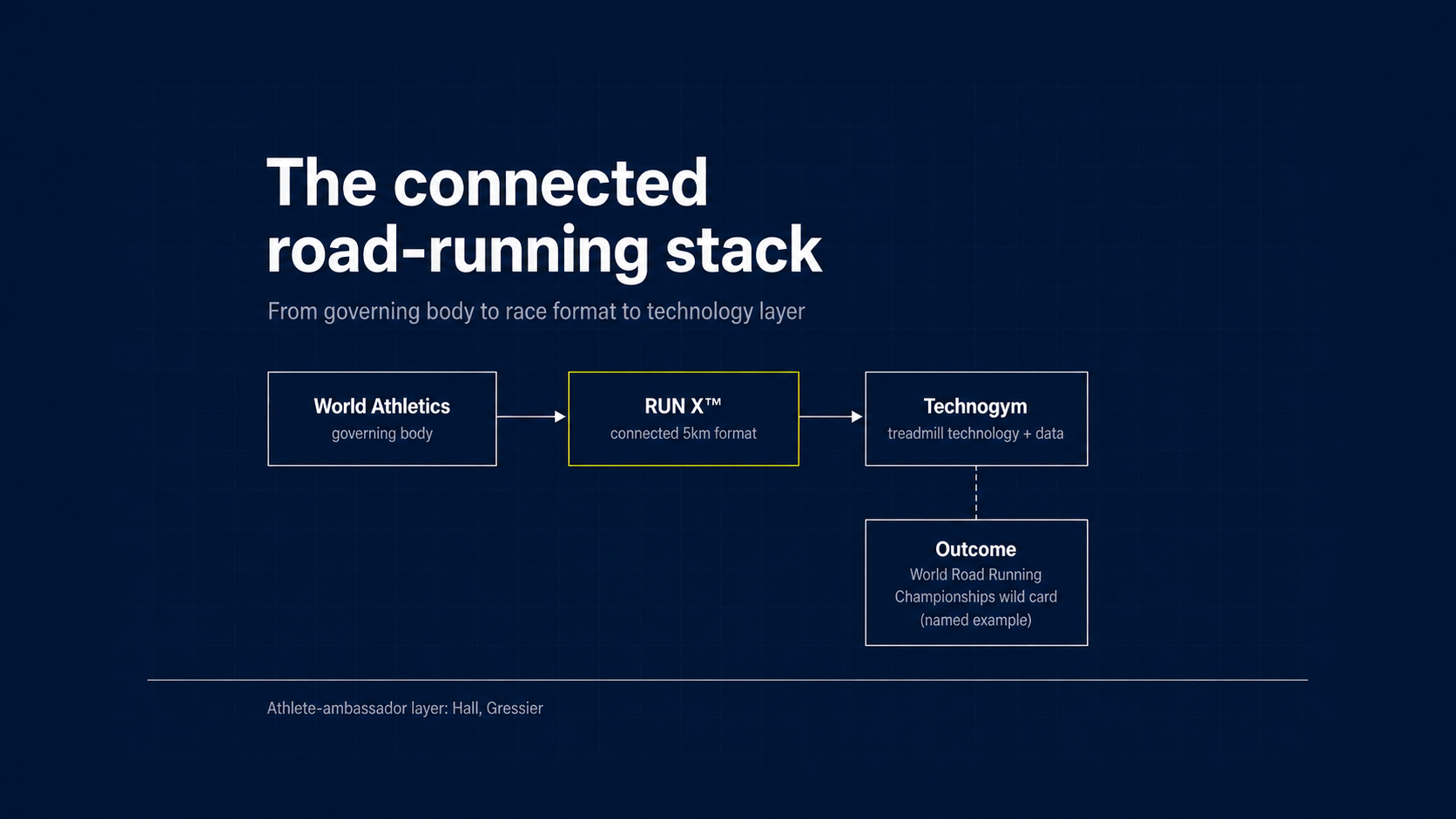
RUN X™ is a virtual 5km treadmill competition, billed as the first World Treadmill Championship. Technogym and World Athletics presented it in Milan on 27 October 2025. The format lets recreational and professional runners compete on connected treadmills at affiliated fitness and wellness clubs, with 5km times certified through Technogym's connected-treadmill ecosystem and ranked on a real-time global leaderboard. The competition carries a US$100,000 prize pool, and, per the published format, World Athletics will grant selected wild-card entries, with the World Road Running Championships named as the example pathway in the launch material.
Two definitions are worth setting down clearly, because they explain the structure. World Athletics is the global governing body for athletics, responsible for the rules and the international competition calendar of track, field and road running. Technogym is an Italian wellness and fitness-equipment manufacturer, listed on Borsa Italiana / Euronext Milan (ticker TGYM), and the company describes itself as holding the largest connected-treadmill installed base of any equipment maker. RUN X™ sits at the join: the governing body lends competitive legitimacy and a pathway to its own events; the manufacturer supplies the hardware, the data certification and the installed base of clubs.
Why this is a technology signal, not a governance one
The signal arrived tagged as governance. On verification it is a sport-technology and commercial-endorsement story, and it reads more clearly that way. The ambassador role is promotional: Hall and Gressier are lending their profiles to a product, not making or changing a rule. Nothing in the announcement touches eligibility, integrity, sanctioning or federation decision-making. What it does touch is the connected-fitness category, the use of certified treadmill data as a competition substrate, and the commercial relationship between a governing body and an equipment manufacturer. That is technology and innovation terrain.
Hall's own framing in the World Athletics release is about access rather than governance. "RUN X™ takes that feeling and opens it up in a really exciting way," she said. "It gives people everywhere the chance to race, connect and push themselves, whether they're chasing a world final or just trying to get the best out of themselves on the day." The pitch is mass participation routed through elite-grade infrastructure, which is precisely the connected-fitness proposition.
The architecture behind the appointment
The more durable observation is not the appointment but the stack it sits on. RUN X™ should be read as more than a vendor product: it combines governing-body legitimacy, Technogym's connected-equipment layer and athlete visibility. It involves at least three distinct roles: World Athletics as the governing body providing the competition pathway and wild cards; Technogym as the technology and data layer, certifying 5km efforts through its digital ecosystem and providing the club footprint; and the athlete ambassadors as the visibility layer. Sebastian Coe, World Athletics President, described the launch in October 2025 as an event that "promises to revolutionise the world of e-sports", positioning the format at the boundary between physical competition and connected platforms. Technogym founder and chief executive Nerio Alessandri framed it as aligned with the company's stated mission to engage more people in regular physical exercise.
For European sport-technology observers, the interesting question is the model, not the marketing. A governing body is using a manufacturer's installed connected-treadmill base to create a globally comparable competition out of distributed, individually logged efforts, with its own competition calendar as the prize. Voice Sport editorial read: that is a specific, repeatable design pattern for connected fitness, and it is worth understanding regardless of how RUN X™ itself performs. This is a Voice Sport reading of a single instance, not a sourced claim of a sector trend; on one product it remains an observation to test, not a movement to assert.
What the appointment does not tell us
It does not, on its own, establish a trend. This is one product with two named ambassadors. There is no second comparable governing-body connected-treadmill competition to read alongside it, so the honest framing is a single instance and a watch item, not a movement. Treating one ambassador announcement as evidence of a sector-wide shift would overstate it.
It also tells us nothing about commercial performance. Technogym is a listed company, and the appropriate discipline is to report only what the parties have stated: the format, the prize pool, the wild-card mechanism and the October 2025 launch. The announcement carries no participation figures, no club-affiliation numbers and no revenue framing, and none should be inferred. Whether RUN X™ reaches meaningful scale is unknown and will be visible only once the competition runs: per the RUN X registration release, qualifications are scheduled from October 2026, with the world final on 20 to 21 March 2027 at Technogym Village in Cesena, Italy.
Forward look
The concrete things to watch are narrow and dated. The first is uptake: how many clubs affiliate and how many runners register through 2026, which World Athletics and Technogym have signalled as the rollout sequence ahead of qualifications from October 2026 and the world final on 20 to 21 March 2027. The second is whether the wild-card pathway to the World Road Running Championships actually moves recreational runners into a World Athletics Series event, which would be the most concrete link between the connected-fitness format and the formal competition calendar. The third, and the only one that would justify the word "pattern", is whether any other federation builds a comparable connected-fitness competition. If one does, this appointment becomes an early data point in a category worth a deeper treatment. If none does, RUN X™ remains a single, well-promoted experiment.
For now, the measured read is that a global governing body and a listed equipment manufacturer have built a connected-fitness competition and given it an athlete face. That is a genuine product signal about one possible direction for governing-body technology partnerships — one instance to watch, not yet a settled direction.
Sources
- World Athletics, "Hall joins Gressier as RUN X™ ambassador" (worldathletics.org/news/press-releases/hall-gressier-run-x-treadmill-ambassador).
- World Athletics / Technogym, "Technogym and World Athletics present RUN X™, the first World Treadmill Championship" (worldathletics.org/news/press-releases/technogym-run-x-world-treadmill-championship).
- World Athletics / Technogym, "RUN X™ opens registration for official centres ahead of first World Treadmill Championship" (worldathletics.org/news/press-releases/run-x-registration-centres-world-treadmill-championship).
- CITIUS Mag, "World Athletics, Technogym to Launch World Treadmill Championship in 2026" (citiusmag.com/articles/world-athletics-treadmill-world-championship-2026-technogym-run-x).
- Borsa Italiana, "Technogym S.p.A. company profile (BIT: TGYM)" (borsaitaliana.it/borsa/azioni/profilo-societa-dettaglio.html?isin=IT0005162406&lang=en).