DMC Production Germany has been appointed technical service provider and studio partner for MagentaTV's FIFA World Cup 2026 coverage, SVG Europe reported on 22 May 2026. The published partner network is broader than the headline appointment. Deutsche Telekom's parallel release the same day names a ten-vendor stack, including thinXpool TV as general contractor for Deutsche Telekom, TV Skyline on the New York transmission side, MTI Teleport providing transatlantic fibre into the FIFA International Broadcast Centre in Dallas, and a layer of social-media, advertising and systems-integration vendors. The tournament is hosted across Canada, Mexico and the United States from 11 June to 19 July 2026 [per FIFA's official match schedule].
The signal in this announcement is operational rather than commercial, and it has two layers. The first layer is what MagentaTV is publishing about a single-broadcaster production architecture at FIFA World Cup scale. The second layer, underneath it, is what the supplier identity reveals about European broadcast production ownership: DMC Production Germany itself is a structurally new entity, formed nine months ago from a German-Swedish-Anglo consolidation.
The Plazamedia continuity behind the new corporate name
DMC Production Germany GmbH was formed on 9 July 2025 when Sweden-headquartered DMC Production acquired two German broadcast production businesses in parallel: Plazamedia GmbH (sold by Sport1 Medien) and rt1.tv mobile.production GmbH, and merged them into a single entity. Plazamedia, headquartered at the AGROB Medienpark in Ismaning, in Munich's broadcast-technology cluster, was founded in 1976; the company carried close to fifty years of German sport-broadcast production history when it changed corporate ownership.
DMC Production's own ownership sits with two financial investors: Coral Tree Partners, a Los Angeles media-investment firm, and Stena Adactum, the diversified investment arm of Sweden's Stena family group based in Gothenburg, alongside DMC management. DMC was founded in 2016 from the European operations of Lagardère Sports and has since added DMC Norway (2022, anchored to TV2 Norge), DMC Netherlands (2023, anchored to VodafoneZiggo's Ziggo Sport) and Matchday Production in Denmark (2024) before the German acquisition in 2025. The German addition is the group's first true acquisition rather than a greenfield establishment.
The MagentaTV relationship pre-dates the corporate restructure. Plazamedia produced MagentaTV's FIFA World Cup Qatar 2022 coverage from its XR LED hybrid studio in Ismaning, with six UHD/HD channels across 23 live game days, per SVG Europe's 2022 coverage. The current 2026 engagement is therefore continuity of the Plazamedia-MagentaTV relationship under DMC corporate ownership, not a new partner acquisition. For European broadcast production observers, the more structural signal is that Plazamedia's nearly-fifty-year German-anchored corporate identity is now part of a Nordic-Anglo-American ownership group operating across at least four European markets.
The full vendor stack
Deutsche Telekom's 22 May press release names the production partner network. The architecture is a coordinated multi-vendor stack rather than a two- or three-party arrangement:
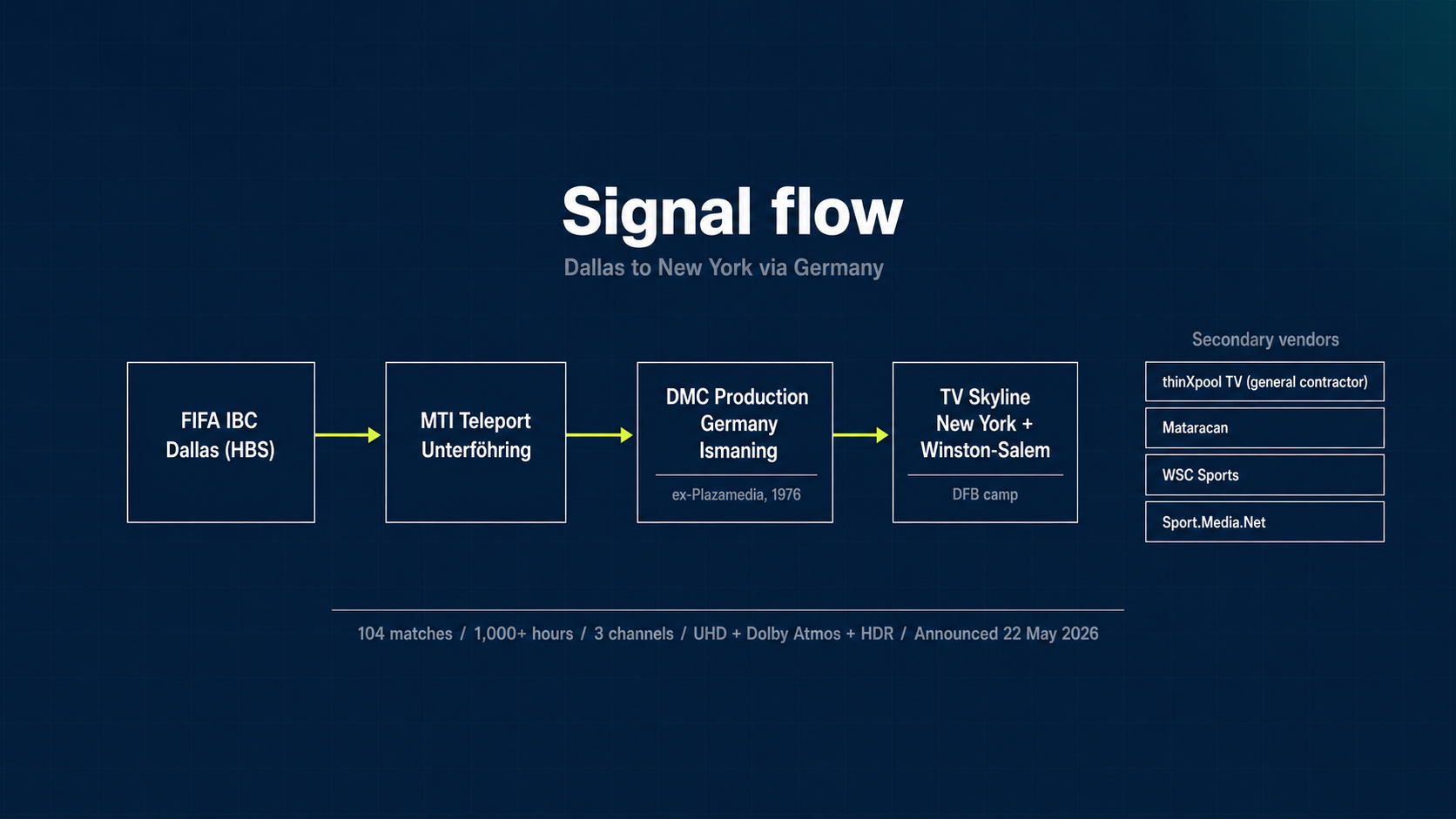
- FIFA IBC Dallas — the FIFA International Broadcast Centre at the Kay Bailey Hutchison Convention Center in downtown Dallas, 45,000 m², operated by HBS (Host Broadcast Services), active January to July 2026, providing the source feed for every national broadcaster on the tournament
- MTI Teleport GmbH (Unterföhring, near Munich) — transatlantic fibre connectivity Dallas IBC ↔ Germany
- DMC Production Germany GmbH (Ismaning) — technical service provider and studio partner, gallery operations, IP signal management, playout, LED integration, graphics, production infrastructure across the Ismaning hub and the New York studio
- TV Skyline — New York studio transmission technology and remote coverage of the German national team's training camp in Winston-Salem, North Carolina
- thinXpool TV GmbH — general contractor for Deutsche Telekom, broadcast operator with overall editorial and production responsibility; DMC Production Germany operates as thinXpool's primary studio sub-contractor in the chain
- Mataracan GmbH — social media editorial content, creator-partnership coordination
- WSC Sports — AI-based highlight automation and content distribution
- Sport.Media.Net GmbH — advertising sales and digital ad-server operation
- Isar Production Management — production-to-digital-platform coordination
- MMO GmbH — systems integration
- BDA Creative (Munich) and Jürgen Bieling — visual identity, graphics and studio design across Ismaning and New York
The chain of responsibility, on the published Deutsche Telekom account, is hierarchical: Deutsche Telekom contracts thinXpool TV as the broadcast operator; thinXpool TV in turn contracts the studio production layer to DMC Production Germany. This is what Jens Friedrichs, Managing Director of DMC Production Germany, addresses in the SVG Europe statement: "As technical service provider and studio partner, we are responsible for the overall planning, integration and operation of the complete studio production infrastructure. Our goal is to create a highly available, scalable and future-proof environment, from signal routing and IP-based workflows to cross-platform UHD and Dolby Atmos distribution. This ensures that MagentaTV can deliver a premium live viewing experience throughout the FIFA World Cup 2026."
Holger Enßlin, the second Managing Director of DMC Production Germany, frames the partnership architecture itself: "This project demonstrates how essential the interaction between technology, processes and strong partnerships is for a global sporting event. Together with MagentaTV and thinXpool, we are implementing international production architecture designed for maximum flexibility and efficiency."
The point Voice Sport readers should take from the vendor stack is that the meaningful architectural unit at FIFA World Cup scale is the coordinated chain, not any individual vendor. A reference architecture for FIFA tournament coverage at this scale is the multi-vendor stack-orchestration, not the single appointment headline.
MagentaTV's published programme
MagentaTV's coverage will include 104 matches, of which 44 are exclusive games to the platform, and more than 1,000 hours of programming. Three dedicated FIFA World Cup 2026 channels will provide continuous coverage alongside highlights, relive content and documentaries. Content delivery is UHD with Dolby Atmos, with accessibility features including audio description. The production chain operates fully in HDR.
On the German free-to-air side, Deutsche Telekom has sublicensed 60 of the 104 matches, split equally between ARD and ZDF (30 matches each), per Sportcal's 22 May coverage of the sublicensing arrangement. The remaining 44 matches are MagentaTV-exclusive. The public-private structure on the German side is therefore three-broadcaster (ARD plus ZDF free-to-air plus MagentaTV pay) rather than the single-broadcaster picture the architecture announcement might suggest at first read.
Two physical studios anchor the production architecture:
- New York City's Financial District — the main hub providing live analysis and stadium-side content across North America
- AGROB Medienpark Ismaning (Munich broadcast-technology cluster) — the MagentaTV home studio, including a dedicated studio space, and the central control hub for the remote production workflow supporting the New York studio
Live production operations are managed remotely from Germany. MagentaTV's presenter lineup includes Johannes B. Kerner and Laura Wontorra, supported by analysts and contributors including Jürgen Klopp, Thomas Müller, Mats Hummels, Wolff Fuss and Tabea Kemme. Additional formats including the "WM Breakfast Club" with Sascha Bandermann and Laura Hoffmann carry separate presenters.
What is structurally new and what is not
Remote and IP-based broadcast production at major-event scale is not new in European sport. Sky Sports has produced Premier League content from remote galleries for years; BT Sport (now TNT Sports) and NEP Group operate pan-European remote production routinely; ITV ran UEFA EURO 2024 on remote workflows; UEFA's in-house production operation has been IP-based for several tournament cycles. The transition from "experimental" to "working model" happened across the 2018 to 2022 broadcast cycles. What is new in the MagentaTV-DMC announcement is the scale at which the architecture is published: 104 matches across three time zones in three host countries, three dedicated channels carried continuously, UHD with Dolby Atmos plus full HDR delivered end-to-end through an IP-routed signal chain, with the source feed originating at a single FIFA IBC in Dallas and being redistributed transatlantically through a multi-vendor European stack.
Two further dimensions of the announcement are worth marking explicitly:
- The signal-origin point matters. FIFA's choice of Dallas for the IBC (in preference to Atlanta, Houston, Toronto or Mexico City) is a broadcast intelligence signal on its own. Dallas is a competitive hosting market with a strong convention infrastructure; FIFA's selection commits every national broadcaster to a transatlantic fibre routing for the tournament window. MagentaTV's MTI Teleport node in Unterföhring is the German end of that decision.
- Sustainability and operating economics are part of the remote-production case. Remote production at this scale reduces crew travel, on-site equipment shipment and tournament-window personnel deployment, with measurable carbon-footprint and cost effects. SVG Europe's own One Planet initiative tracks this dimension across European broadcasters; the published MagentaTV architecture sits inside that broader sustainability brief, even if Deutsche Telekom's 22 May release does not name it explicitly.
The financial terms of the MagentaTV-thinXpool TV-DMC engagement are not disclosed in the published statements; financial terms in this category of broadcast-production contract are typically held confidentially.
What European broadcasters and rights holders should be watching
The concrete European 2026 World Cup broadcast landscape, on what is presently published, runs through a recognisable national broadcaster set. The interesting watch question is which production partners each national broadcaster announces:
- United Kingdom: BBC and ITV share all 104 matches equally; production partner not yet publicly named
- Germany: ARD and ZDF (free-to-air, 60 matches sublicensed from Deutsche Telekom, 30 each) plus MagentaTV (44-exclusive plus all 104); MagentaTV stack is the subject of this article
- France: TF1 (free-to-air) and beIN Sports (premium)
- Italy: RAI (free-to-air, including the opener, quarter-finals, semi-finals and final) and DAZN (all 104)
- Spain: RTVE (national team and selected matches free-to-air), DAZN and Mediapro
- Ireland: RTÉ
- Pan-European: WBD (Warner Bros. Discovery) Europe / Eurosport across rights packages
- Nordics: NRK, SVT, Yle, TV2 Denmark, TV2 Norge
Three watch items follow:
- Production-partner announcements from the remaining European national broadcasters — particularly BBC, ITV, RAI, TF1 and RTVE — and the specific vendor stacks they publish ahead of the tournament window
- The DMC Production European footprint — DMC Production now operates production businesses in Sweden, Germany (post-Plazamedia merger), Norway, the Netherlands and Denmark; whether further national-market acquisitions or greenfield expansions follow before the 2026 cycle closes is a consolidation signal for the sector
- The position of comparable consolidators — particularly NEP Group at pan-European scale and any French, Italian or Iberian regional consolidators — relative to DMC at the next FIFA, UEFA and Olympic broadcast tendering rounds
The reasonable read of the 22 May package is that the published reference unit is the coordinated multi-vendor stack rather than any single vendor appointment. The European broadcast production landscape is consolidating into a smaller set of multi-market production groups; DMC Production Germany is one node in that consolidation, and the MagentaTV-thinXpool TV-DMC architecture is one published reference for how that node operates at FIFA tournament scale.
What is uncertain
The financial terms of the MagentaTV-thinXpool TV-DMC engagement are not publicly disclosed. Production-partner announcements from BBC, ITV, RAI, TF1, RTVE, RTÉ and the Nordic public-service broadcasters are not yet on the public record at the time of this article; their architectures may or may not parallel the MagentaTV stack. Comparable disclosure across other major-event broadcasters in the 2026-2028 window (UEFA EURO 2028, FIFA Women's World Cup 2027 in Brazil, Milano-Cortina 2026) will be the test of whether the MagentaTV reference is sector-wide practice or one operator's specific architecture.
Forward look
Three watch items across the next 12 to 24 months:
- European broadcaster production-partner announcements for FIFA World Cup 2026 — specifically BBC, ITV, RAI, TF1, RTVE and the Nordic public-service broadcasters
- DMC Production Group expansion — further European national-market acquisitions or greenfield establishments before and after the 2026 tournament window
- Comparable broadcast-production consolidator activity — particularly NEP Group at pan-European scale, and the position of national-market consolidators in France, Italy and the Iberian region
Sources
- Deutsche Telekom, "FIFA WM 2026: MagentaTV setzt auf starkes Netzwerk", press release, 22 May 2026 (telekom.com)
- SVG Europe, "DMC Production Germany appointed technical service provider and studio partner for MagentaTV's FIFA World Cup 2026 coverage", 22 May 2026
- DMC Production, "DMC Production acquires Plazamedia and rt1.tv mobile.production to launch DMC Production Germany", press release, 9 July 2025 (dmcproduction.com)
- Broadband TV News, "Sport1 sells Plazamedia to DMC Production, merges with rt1.tv", 10 July 2025
- SVG Europe, "MagentaTV at FIFA World Cup Qatar 2022: Plazamedia XR LED studio production", 2022
- Sportcal, "ARD and ZDF agree sublicensing deals with Deutsche Telekom for World Cup and Euros" (sportcal.com)