Liga MX, Mexico's top professional football league, has signed a licensing deal to return to the EA Sports FC video game franchise through June 2029, in a non-exclusive arrangement at the league level. Sportico reported the contract specifics on 21 May 2026, building on earlier reporting: Soy Fútbol broke the existence of the deal first, and Raoul "Pollo" Ortiz (Fox Sports Mexico, "LUP" programme) confirmed the EA return on 10 April 2026. Liga MX and Electronic Arts declined to comment for Sportico's piece.
The reasonable read is that the announcement sits at the intersection of three structural contexts that matter more to European football observers than the Liga MX-Mexico licensing detail on its own: the FIFA-EA divorce of May 2022 and the football video-game IP restructuring that followed; the club-level operational complexity of Konami's Liga MX exclusive arrangements unwinding through 2025; and the regulatory close window of the USD 55 billion PIF-led EA take-private that defines the corporate ownership context in which the new Liga MX deal will execute.
The FIFA-EA divorce of May 2022 is the backbone of this story
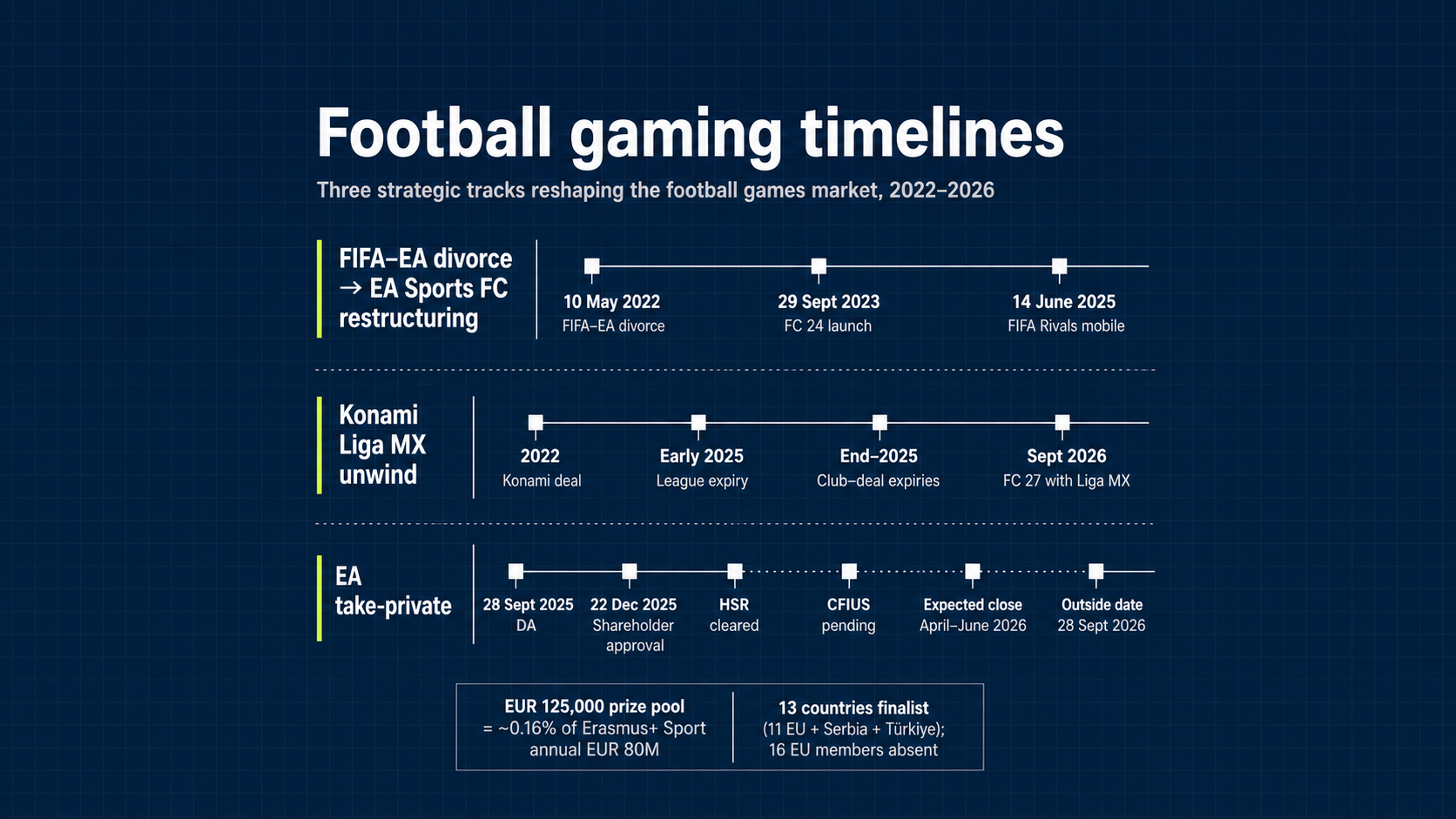
On 10 May 2022, Electronic Arts and FIFA announced the end of a partnership that had run since 1993 and generated over USD 20 billion in lifetime revenue across the FIFA video-game franchise, per Fortune. FIFA had reportedly asked EA to roughly double its existing USD 150 million annual licensing fee to approximately USD 250 million per year, or to commit to a deal approximating USD 1 billion per four-year World Cup cycle. EA declined and ended what was, in lifetime revenue, the most valuable single licence in football gaming.
The branded outputs of that split arrived sixteen months later. EA Sports FC 24 launched on 29 September 2023 as EA's continuation of the football video-game franchise under a new brand. FIFA's own competing product arrived in mid-2025: FIFA Rivals, a mobile arcade game developed with Mythical Games, launched globally on 14 June 2025, timed to the FIFA Club World Cup window. FIFA Rivals is mobile and arcade-style; it is not a console-tier rival to EA Sports FC.
The May 2022 split restructured the football video-game licensing market in a way that matters for Liga MX's 2026 return. EA, freed from the FIFA-brand exclusive structure, opened licensing on more flexible terms across leagues and competitions; FIFA's competing product never reached a console scale that could absorb the same league-level licences. The economic field for league-level football video-game rights between 2022 and 2025 was therefore reshaped: leagues were no longer choosing between FIFA-branded EA and Konami's eFootball, but between Konami and the rebranded EA Sports FC. Liga MX moved to Konami in 2022 inside that restructuring window. The 2026 return to EA closes one arc of that movement.
The Konami unwind: why the timing landed at FC 27
Konami's league-level exclusivity for Liga MX in eFootball reportedly ended in early 2025. Despite that, Liga MX was not in EA Sports FC 26, which launched in October 2025. The reason, on the published trade-press reading, is that several Liga MX clubs held separate exclusive Konami arrangements that extended beyond the league-level deal: specifically Club América, Chivas (Guadalajara), Pumas UNAM and Tigres UANL, with some trade press also naming Cruz Azul and Monterrey in the same Konami-exclusive frame. Those club-level deals reportedly ran into the end of 2025. Club América, on more recent reporting, has continued an exclusive arrangement with Konami eFootball into 2026 separately from the broader Liga MX-EA deal.
The new EA Sports FC 27, scheduled for the franchise's annual September release window in September 2026, is therefore the first EA Sports FC release after the entire Konami club-level Liga MX exclusive layer has unwound (with the exception of Club América, which the published deal will need to accommodate). The timing is not a coincidence: it is the first window in which Liga MX could enter EA Sports FC at the league level without leaving most of its clubs visibly contradicted on the rival platform.
That operational lesson is the most transferable element of this story to European football. League-level video-game licensing decisions are not self-completing; if individual clubs have independent exclusive arrangements with the alternative publisher, the league-level deal cannot be fully activated until those club deals also expire. The European parallels are direct: Juventus held a Konami exclusive from 2019 and appeared in EA's FIFA 20, 21 and 22 as the generic "Piemonte Calcio" before EA reacquired the Juventus rights for FIFA 23. Several other Italian clubs (Napoli, Lazio, Roma, Atalanta) carried Konami-exclusive arrangements in the same period. Real Madrid and FC Barcelona retain significant club-level IP autonomy within La Liga's central rights structure, with image rights and licensing components negotiated at club level. Premier League central rights are wide, but image rights remain fragmented across clubs and individual players. The "Piemonte Calcio" pattern shows that fragmentation can survive at the publisher-visible layer for multiple title cycles.
The PIF-led EA take-private is in regulatory close, not "expected to"
The Liga MX deal will execute under a different EA corporate ownership than the one in place when the original 2022 Liga MX-Konami arrangement was signed. The definitive merger agreement for Electronic Arts to be taken private by a consortium led by the Public Investment Fund (PIF) of Saudi Arabia, with Silver Lake and Affinity Partners as co-investors, was signed on 28 September 2025. The enterprise value is approximately USD 55 billion, at USD 210 per share in cash (a 25 per cent premium to the unaffected share price), funded through approximately USD 36 billion of equity and USD 20 billion of debt arranged by JPMorgan. EA's own framing of the transaction in its 28 September 2025 release is "the largest all-cash sponsor take-private investment in history".
The status of the transaction is in advanced regulatory close, not in early speculative stage. EA shareholders approved the merger on 22 December 2025, with greater than 99 per cent of voted shares in favour (approximately 201 million for, fewer than 2 million against), per Bloomberg's coverage of the shareholder vote. HSR antitrust clearance has already been obtained. The outstanding regulatory step is the CFIUS (Committee on Foreign Investment in the United States) review of the foreign-investment dimension. The agreement carries an expected close window inside EA's fiscal Q1 2027, that is, April to June 2026, with an outside date of 28 September 2026 and a USD 1 billion reverse break fee payable by the consortium if regulatory close is not achieved.
For the Liga MX deal, the relevant point is the commercial timing alignment: an EA Sports FC 27 release scheduled for September 2026 will, under the agreement's outside date and expected close, fall after the PIF-led ownership change is complete (or, if not yet closed, in the immediate window before the outside date). The new Liga MX licensing arrangement, signed under the current EA ownership but executing across the franchise's next several release cycles, is one of the first major league-level licensing decisions that will operate across the EA ownership transition.
This article does not impute the outcome of the CFIUS review or the consequential operational consequences of any specific corporate ownership configuration. The factual status of the transaction (definitive agreement signed, shareholder-approved, HSR-cleared, CFIUS-pending) is the documentable point; the operational consequences for licensing strategy under new ownership are appropriately observed across the next several EA Sports FC release cycles, not predicted now.
PIF's Latin American gaming context, carefully scoped
PIF operates one of the largest sovereign-wealth gaming portfolios in the sector. Beyond the pending EA acquisition, PIF holdings and influences include Savvy Games Group (PIF's direct gaming holding vehicle), Scopely (which has subsequently combined with Niantic's gaming assets), ESL FACEIT Group, and a holding in Embracer Group. PIF has signalled Latin American engagement through the FII Priority Summit held in Miami, with PIF Governor Yasir Al-Rumayyan participating in regional positioning discussions.
A specific PIF-Mexico gaming investment thesis is not on the public record at this stage. The factual position is that PIF holds the EA acquisition agreement at advanced regulatory close, that PIF carries a stated Latin American engagement signal, and that the Liga MX-EA Sports FC arrangement is one major Latin American football-IP licensing deal that will execute inside the EA-PIF ownership window. Whether that constitutes a coordinated strategy or temporal coincidence is a question to be observed across subsequent Latin American league-level licensing announcements under EA Sports FC, not a thesis to advance from a single data point.
What this means for European football (and where the relevance is)
A direct read across to European top-tier domestic leagues is structurally limited. EA Sports FC's published portfolio includes exclusive partnerships with the Premier League, La Liga, Bundesliga, Serie A, Ligue 1 and MLS, with the five major European leagues all in place under exclusive arrangements (the existing structure has been the published EA Sports brand messaging since the FC 24 launch). Liga MX's non-exclusive return structure is therefore not a template for the European top tier; those leagues are already inside EA Sports FC under different commercial terms.
The genuine European relevance is at the mid-tier domestic league layer, where existing video-game IP arrangements are more variable and renewal cycles are more open. The relevant European leagues to watch are the Eredivisie (Netherlands), the Belgian Pro League, Ekstraklasa (Poland — already on the data-rights side discussed in this week's W22 European Leagues/Foova signal), the Primeira Liga (Portugal), the Scottish Premiership, the Süper Lig (Turkey) and the Super League (Greece). For these leagues, the structural questions raised by Liga MX-EA are operationally relevant: whether non-exclusive multi-publisher league-level licensing becomes a more standard renewal structure, whether club-level rights fragmentation persists or consolidates, and how Konami's eFootball as the alternative publisher positions across the 2026-2029 renewal window. A separate sector-relevant question for mid-tier European leagues is whether the PIF-Latin-American framing observed (carefully) around Liga MX has a southern-European or Mediterranean parallel as the PIF EA ownership beds in.
Mexico-WC2026 commercial timing as a weak signal
One additional dimension worth marking: EA Sports FC 27's September 2026 release falls approximately two months after the FIFA World Cup 2026 final on 19 July 2026, and Mexico is a co-host of the tournament. The Liga MX-EA return is therefore landing at the post-tournament attention peak window for Mexican football audiences. Whether the licensing arrangement was timed deliberately to that audience window or arrived inside it coincidentally as a function of the Konami club-deal expiry calendar is not public; the temporal alignment is observable, the causal claim is not assertable. For European football observers, this is a tournament-cycle-aware licensing-strategy reading worth tracking as the EA Sports FC 27 marketing approaches.
What is uncertain
Several specific elements of the Liga MX-EA deal are not on the public record at this stage. Exact financial terms are not disclosed; Sportico reports that the deal represents "a significant increase in compensation" compared to the prior Liga MX-Konami arrangement, but no figures. The deal is at the league level, though it is unclear whether all 18 Liga MX clubs are covered (Club América's continuing Konami exclusive being the most visible exception). Konami's eFootball positioning in Mexico from FC 27 onwards has not been publicly stated. The CFIUS review timeline for the EA take-private has not been published. The PIF-LatAm gaming-strategy framing remains a soft observation, not a documented thesis.
Forward look
Three watch items across the next 12 to 24 months:
- EA Sports FC 27 Liga MX deployment (September 2026 release window) and which Liga MX clubs are covered in that release, alongside Club América's continued Konami exclusive
- Mid-tier European league video-game licensing renewals — Eredivisie, Belgian Pro League, Ekstraklasa, Primeira Liga, Scottish Premiership, Süper Lig, Greek Super League — and whether the Liga MX non-exclusive pattern recurs at any of those renewal moments
- The first major league-level video-game licensing announcement under post-close PIF EA ownership (assuming CFIUS clearance) and whether any pattern emerges in Latin American or southern-European licensing under new ownership
The reasonable editorial position is to read the Liga MX-EA deal as a first significant league-level licensing data point in the FIFA-EA divorce aftermath, anchored by a fully documentable operational lesson on club-level rights timing, sitting inside an advanced-regulatory-close EA ownership transition. The pattern claim — whether Liga MX is the first of several similar mid-tier league reverts to EA Sports FC — is a hypothesis to track, not a thesis to assert from a single data point.
Sources
- Sportico, "Liga MX Signs Deal to Return to EA Sports FC Video Game", 21 May 2026 (sportico.com) — citing Soy Fútbol as first to report and confirming non-exclusive league-level structure through June 2029
- Raoul "Pollo" Ortiz, Fox Sports Mexico ("LUP" programme), reporting on Liga MX return to EA Sports FC 27, 10 April 2026 (foxsports.com.mx)
- Electronic Arts investor relations, "EA Announces Agreement to be Acquired by PIF, Silver Lake and Affinity Partners for USD 55 Billion", 28 September 2025 (ir.ea.com)
- Bloomberg, "Electronic Arts Shareholders Approve USD 55 Billion Sale to Saudis", 22 December 2025 (bloomberg.com) on >99% shareholder approval and HSR clearance
- Fortune, "EA Sports loses FIFA video game franchise after 30-year partnership, USD 20 billion in revenue", 11 May 2022 (fortune.com)
- FIFA, "Mythical Games and FIFA team up to bring new football arcade game FIFA Rivals", 14 June 2025 (inside.fifa.com)
- ESPN, "Juventus return to FIFA 23 after years of being replaced by Piemonte Calcio"