Play the Game, the Danish sports media and governance research organisation, published an investigation this week into how the International Cricket Council allocates development funding to its Associate Member nations. The investigation raises serious questions. It also draws distinctions that deserve to be carried forward into how the story is read — including the distinction between documented structural vulnerabilities and independently verified manipulation.
Both matter. The structural vulnerabilities are real and the governance analysis they support is sound. But reporting that conflates the investigation's documented findings with its sourced allegations does a disservice to both the investigation and to the governance case it makes.
---
What the Investigation Did and Did Not Document
Play the Game's investigation is based on a range of sources: published guidelines, institutional documents, and accounts from administrators and observers — many of them anonymous. The investigation notes explicitly that it did not independently verify specific allegations of manipulation.
The investigation surveyed 96 Associate Member federations; 80 did not respond, ten declined to participate, six commented, and one — Norway — provided participation data. This context does not invalidate the investigation's structural analysis. It does set appropriate limits on how the allegation-based material should be characterised.
The ICC did not respond to Play the Game's comment requests over a seven-month period. Non-response is a documented fact about the ICC's engagement with the investigation. It is not evidence that the claims are accurate, nor an acknowledgement that they are.
The investigation's structural analysis — about the design of the Scorecard, the incentive structure it creates, and the transparency mechanisms that have been reduced — stands on its own terms and warrants serious governance attention.
---
What the Scorecard Is
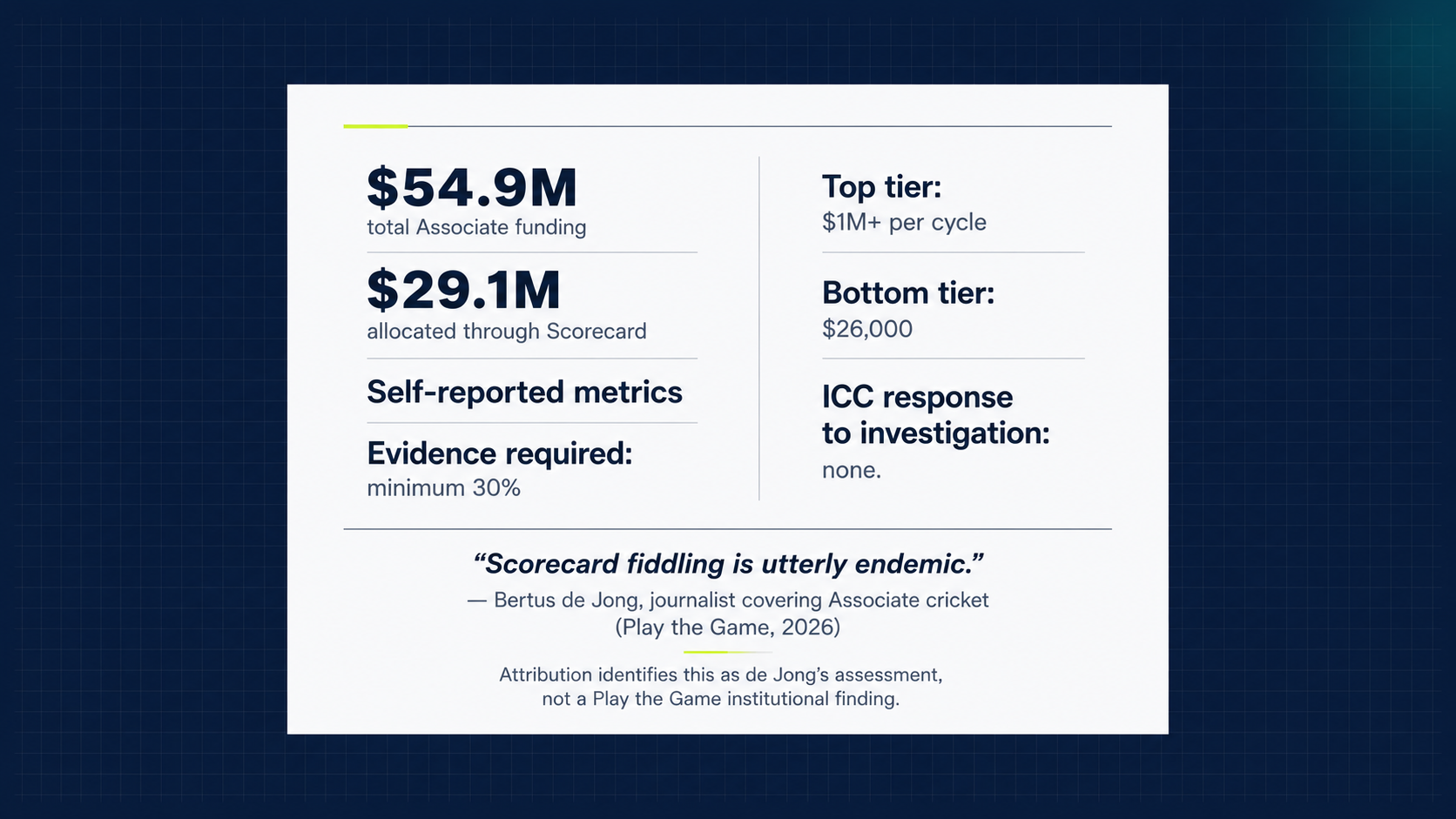
The ICC's total 2026–27 Associate Member funding pot is approximately $54.9 million. Of that, around $29.1 million is allocated through the Scorecard grant — a tier-based allocation calculated using participation, infrastructure, and income data submitted by member associations themselves. A further $25.7 million goes to competition funding. The development programme is larger than the Scorecard alone.
The Scorecard's incentive logic is straightforward: associations that can demonstrate growing participation and improving infrastructure receive more funding. The design choice to use self-reported metrics for this purpose is common in development funding across international sport. It is also the design choice that creates the central governance vulnerability Play the Game's investigation examines.
ICC guidelines reportedly require evidence for at least 30% of submitted Scorecard data — a minimum evidential threshold rather than a verification-absent system. Play the Game's sources questioned whether regional teams have sufficient capacity to apply that requirement consistently, and whether the threshold is adequate relative to the financial stakes involved. Separately, two anonymous participants told the investigation they had experienced audits — one reported being audited in 2024. The public record does not permit assessment of how comprehensive audit coverage is, how outcomes are documented, or whether the process functions as intended.
This is the picture the investigation establishes: not "no verification exists" but rather "the verification that exists may not be consistently or sufficiently applied, and external confirmation is not available." The governance implications of those two descriptions are different in degree, not in kind.
---
The Incentive Structure
The financial stakes are large enough to make the verification question consequential.
Top-tier Associate Members — the UAE and Scotland, for example — each receive over $1 million in Scorecard grants per cycle. Members at the lower end receive as little as $26,000. A single position in the ranking separates substantially different funding levels. When rank position is this valuable, the metrics that determine rank are correspondingly valuable — and the governance cost of those metrics being inaccurate is high.
Play the Game documents allegations from anonymous administrators about specific practices through which the incentive to optimise figures may have been acted on. An anonymous Associate board chair described to the investigation how an 11-player competition could, under a particular interpretation of counting guidelines, be recorded as 15 participants for Scorecard purposes. Play the Game notes this was not independently verified, and the published extract from the guidelines does not explicitly authorise that reading. The account illustrates the interpretive latitude some actors perceive in the system — which is a governance concern regardless of whether that specific practice can be confirmed.
Bertus de Jong, a journalist who has covered Associate cricket for more than a decade, offers his own assessment of what he has observed across the sector: "Scorecard fiddling is utterly endemic." This is de Jong's description of what he has seen, not the Play the Game investigation's own institutional finding.
The combination — high financial stakes at the margin, self-reported metrics, and limited public visibility into verification — is the structural vulnerability Play the Game is identifying. Whether that combination has produced systematic manipulation across the Associate membership, manipulation in some cases, or principally the conditions for manipulation, is not established by the investigation.
---
The Transparency Question
A separate strand of the investigation concerns the reduction of publicly available data.
The ICC previously published what it called the Census — a document providing detailed participation, infrastructure, and engagement figures across Associate Members. The last publicly announced Census data release appears to be from 2020, covering 2019 figures. The Census was based largely on self-reported information from member associations; it was a transparency mechanism, not an independent audit. Its value was that it allowed third parties to examine participation figures and make comparisons across the membership — a function that is meaningful even when the underlying data is self-reported.
The ICC no longer appears to publish comparable data in this format. No replacement mechanism providing equivalent external visibility into Associate Member participation figures appears to have been introduced. The effect, in governance terms, is that a transparency layer has been removed from a system whose self-reported metrics already carry the limitations described above. Whatever the administrative rationale for the Census discontinuation, the governance risk of removing an external visibility mechanism from a self-reporting-dependent allocation system is real.
This is a documentable structural point that does not depend on the allegation-based material in the investigation.
---
Design Vulnerabilities Worth Naming
The ICC case, as documented by Play the Game, illustrates governance vulnerabilities that appear across development funding programmes in international sport. They are worth naming explicitly because they are design questions — preventable choices with known governance consequences.
Self-reported metrics with high financial stakes. When the entity that benefits from a metric is also the entity that reports it, the metric will face pressure toward inflation when financial stakes are high. The appropriate governance response is not to trust less but to verify more — through independent sampling, external data cross-referencing, or both.
Interpretive latitude in definitional standards. Counting guidelines that permit multiple interpretations of the same data point will produce multiple interpretations. Whether or not specific guidance has been intentionally misread, ambiguity in metric definitions creates uncertainty that undermines confidence in the allocation it governs. Definitions should be specific enough that there is one reasonable interpretation of each measurement.
High differentials with narrow margins. When adjacent tier positions represent large funding swings, the pressure to protect or improve position by any means available is intense. Funding structures with steep cliff edges should be designed with audit investment proportionate to the stakes at those edges — or structured to reduce the differentials that make those edges so consequential.
Reduction of external transparency. When a transparency mechanism that enables external cross-referencing of self-reported data is discontinued, the governance risk of the self-reporting system increases. The decision to reduce external visibility should be treated as a governance choice with accountability implications, not an administrative convenience.
These are design characteristics, not accusations. Their presence in the ICC system is documentable without resolving the question of whether, or how extensively, they have produced manipulation in practice.
---
What the ICC Should Do
Play the Game's investigation does not make specific structural recommendations. This analysis will.
The ICC should restore external publication of Associate Member participation data in a format that allows third-party comparison — not necessarily the Census in its original form, but something that serves the same external visibility function. The absence of that layer is the most clearly documentable governance deficit the investigation identifies.
The ICC should conduct an independent review of verification practices across Scorecard submissions — not as an accusation of wrongdoing, but as a governance hygiene measure appropriate to the financial stakes of the system. Publishing the findings of that review would address the transparency deficit directly.
The definitional standards for Scorecard metrics should be reviewed with an explicit mandate to identify and close interpretive ambiguities. The review should be conducted by people tasked with finding the ambiguities, not by people assuming they do not exist.
And the ICC should respond to serious investigative journalism about its governance. Seven months of non-engagement with Play the Game's requests is, itself, a governance signal.
None of these recommendations require the ICC to concede wrongdoing. They require it to take the governance design of a $29.1 million annual allocation programme seriously enough to make the verification and transparency mechanisms visible.
---
A Note on the Investigation's Reach
Play the Game's investigation is a serious piece of governance journalism. It also has documented limitations. The investigation reached only 16 of 96 Associate federations in any substantive way; the great majority did not respond to the survey component. The allegation-based material — about specific counting practices, specific instances of guidance exploitation — rests on anonymous sources whose accounts the investigation could not independently verify.
These limitations do not undermine the investigation's structural argument. The structural argument — about incentive design, metric verification, and transparency reduction — does not depend on the allegation-specific material. It depends on the documented design of the Scorecard, the published tier funding figures, and the disappearance of the Census data. That material is solid.
What the limitations do require is precision about what has been established and what has been alleged. The governance case for ICC reform does not need the allegation layer to be proven in order to be compelling. The structural analysis alone makes the case.
---
The Lesson for European Sport Federations
European sport federations operate development funding programmes through Erasmus+, UEFA's HatTrick fund, national lottery allocations, and direct federation investment. Many use participation metrics, infrastructure metrics, or programme-delivery metrics as the basis for grant calculation.
The ICC case is a governance reference point — not a proof that other systems are similarly compromised, but a structured demonstration of how the combination of self-reported metrics, high financial differentials, and limited external transparency creates accountability risk. The design questions it raises are applicable wherever these features are present together.
Voice Sport editorial reading: Federation administrators responsible for development funding design should read the Play the Game investigation and then run the same questions against their own systems: are submitted metrics self-reported without independent sampling? Do tier differentials create strong incentives to optimise at the margin? Is there external visibility into the data that determines allocation? These are not questions that assume manipulation. They are questions that allow governing bodies to document, credibly, that their allocation processes are sound.
---
Sources
Primary source: Play the Game, "'Greed' and loopholes: how cricket's 55 million USD development fund gets gamed," 2026. playthegame.org/news/greed-and-loopholes-how-crickets-55-million-usd-development-fund-gets-gamed/
Institutional transparency reference: ICC, "T20 International Cricket drives significant growth in 2019" (last publicly available Associate Member Census data announcement, 2020). icc-cricket.com/media-releases/t20-international-cricket-drives-significant-growth-in-2019
Funding figures: ICC Associate Member funding framework, 2026–27 cycle: $54.9 million total; approximately $29.1 million Scorecard grant, approximately $25.7 million competition funding. Figures per Play the Game primary investigation.
European context: Erasmus+ Sport funding evaluation frameworks (European Commission); UEFA HatTrick fund (UEFA.com).