The Architecture of Automatic Sanctions
Automatic sanctions — suspensions that trigger without a case-by-case disciplinary hearing — exist in sport for the same reason mandatory sentencing exists in some legal systems: to make outcomes predictable and resistant to external influence. When a red card results in an automatic suspension, everyone knows the consequence before the infraction occurs. The player knows. The team knows. The opposing team knows.
This predictability is not incidental to the rule's purpose. It is the rule's purpose.
The moment the implementation of an automatic sanction becomes subject to discretionary suspension — particularly a suspension that follows a call from a head of state asking for the case to be reviewed — the rule's predictability is compromised in practice, whatever its text still says. That is a structurally weaker governance position, with consequences for every federation that relies on the uniform application of FIFA's disciplinary framework to underwrite its own regulatory credibility.
FIFA's Disciplinary Code contains Article 27, a provision giving FIFA's judicial bodies broad authority to suspend the implementation of all or part of a disciplinary measure, subject to a probationary period. The provision's text does not enumerate the circumstances in which that discretion should be exercised; it excludes only one category from its scope, sanctions imposed for match manipulation, which cannot be suspended under Article 27. Whether its use in the Balogun case was an appropriate exercise of that broad discretion is now a live question, one that UEFA, and subsequently a group of Members of the European Parliament, have answered in public.
---
On 1 July 2026, Folarin Balogun received a straight red card during the United States' 2-0 Round of 32 victory over Bosnia-Herzegovina. The dismissal triggered an automatic one-match suspension under FIFA's disciplinary regulations, the sanction FIFA's framework applies automatically following a straight red card at a World Cup fixture. The mechanism exists for one reason: to remove discretion from enforcement decisions at the point of the infraction.
Within days, President Trump called FIFA President Gianni Infantino. Trump has said he asked Infantino for the case to be reviewed; he has not said he asked for a specific outcome. FIFA's Disciplinary Committee subsequently invoked Article 27 of its Disciplinary Code to suspend the implementation of Balogun's one-match ban for a one-year probationary period. Balogun played against Belgium in the next fixture. The implementation of the ban was suspended; the match was played; the underlying red card and disciplinary sanction were not overturned.
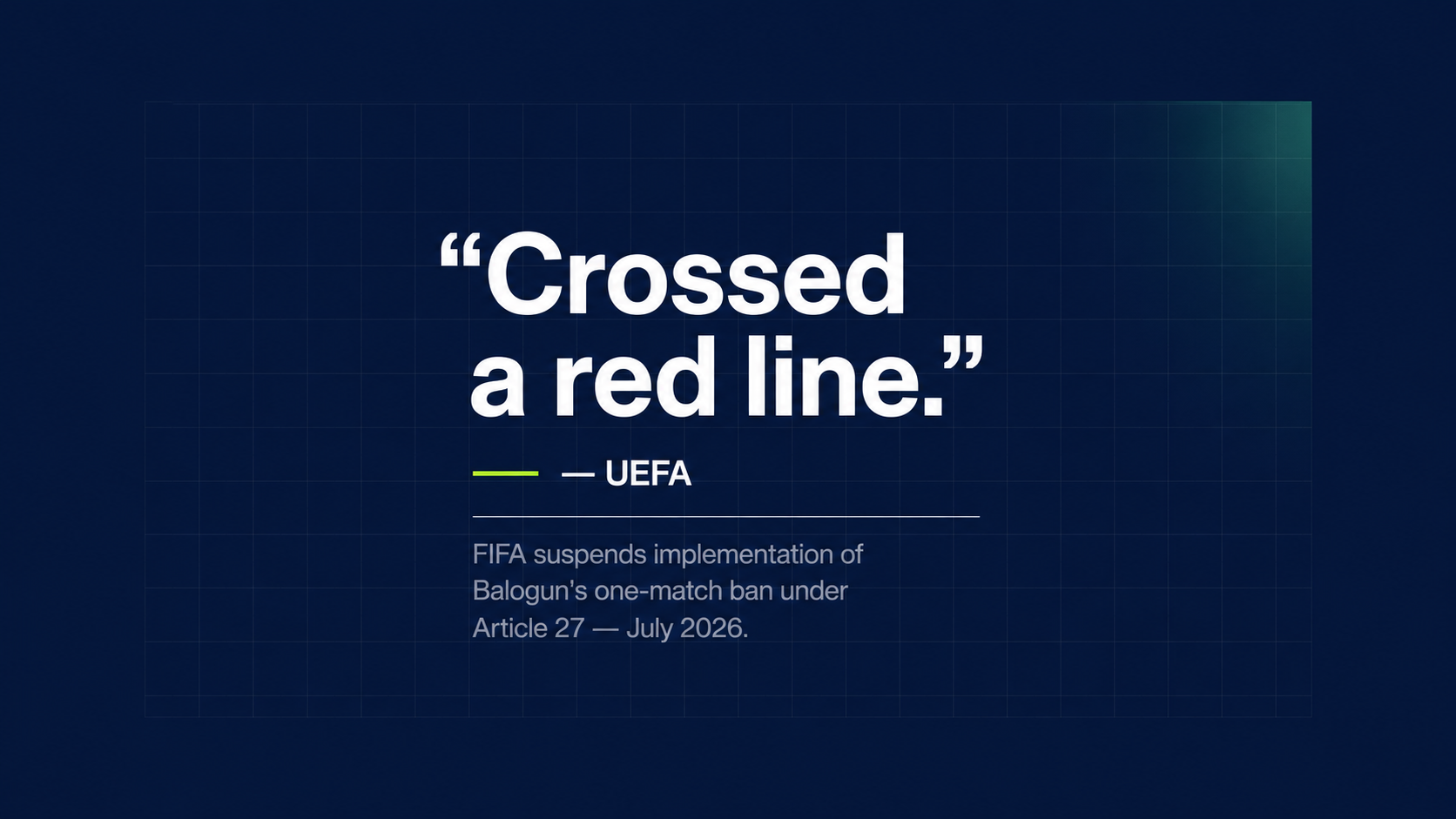
UEFA's response was categorical. In a formal statement, the confederation described the decision as "unprecedented, incomprehensible and unjustifiable," and said it had "crossed a red line," continuing: "A minimum automatic suspension of one match following a red card is not a discretionary option. It is a principle embedded in regulations, which cannot be made subject to exceptions, let alone in the middle of a tournament."
The use of the word "principle" in that sentence is deliberate, and it is where the governance analysis begins.
---
The Infantino Question
Gianni Infantino has stated publicly that he told President Trump during their conversation that FIFA's disciplinary body was independent and that he had not intervened in the decision. That statement contains two claims worth examining separately.
The first, that he told Trump the body was independent, is not in dispute. The second, that he did not intervene, is harder to assess through observable evidence alone. Independence, in governance terms, is not a status that the head of an institution can establish for a subordinate committee by telling a political actor that it is independent. Independence is demonstrated through observable outcomes, particularly outcomes that run contrary to political pressure.
Publicly available evidence does not establish that Infantino instructed the Disciplinary Committee, or that the call determined the outcome. What is documented is the chronology: a call in which a head of state asked for a review, followed within days by a decision favourable to that request. This is not an accusation of deliberate interference. It is a description of what the governance record shows, and what it does not show.
What it shows: a senior political actor made contact with the head of an international sports governing body and asked for a disciplinary case to be reviewed; the disciplinary body then reached a result favourable to that political actor's stated request.
What it does not show: any direct evidence of Infantino instructing the Disciplinary Committee, or any evidence that the committee members did not exercise their own judgment independently.
The gap between those two things is where FIFA's credibility problem lives. In governance, the relevant standard is not only whether interference occurred. The standard is whether the institution maintains conditions under which interference is visibly impossible, or at least improbable, to outside observers. Per the public record of this case, FIFA has not demonstrated those conditions, whatever the internal process actually was.
---
UEFA's Interest and the Wider Federation Response
UEFA's decision to issue a public statement characterising the decision as a "red line" is itself a governance signal of significance. Confederations do not typically criticise FIFA's disciplinary processes in public, in real time, during a running tournament. The fact that UEFA chose to do so indicates that the confederation judged the institutional risk of silence to be greater than the institutional cost of public disagreement with the parent body.
Voice Sport editorial reading: that judgment reflects a concern within European sport governance that if Article 27 can be used this way once, a precedent exists for it to be used again, and that FIFA's capacity to decline a comparable request in future may, in practical terms, be weaker for it.
UEFA represents 55 national associations. The confederation has its own regulatory architecture, including its Financial Sustainability Regulations and its own disciplinary processes, that depends on the credibility of the proposition that rules apply uniformly. Voice Sport editorial reading: a FIFA whose disciplinary decisions can be seen to follow political contact undermines that credibility by association, with implications for the confederations and national associations whose own enforcement regimes are built on FIFA's example.
By 8 July, a group of Members of the European Parliament had written to national football associations asking them to trigger a FIFA Ethics Committee investigation; reporting on 7 July put the number of signatories at 35, and by 10 July that figure had grown to 72. Their letter is addressed not to FIFA directly but to the national associations, the FIFA members who collectively hold the institutional accountability levers described above. Whether those associations choose to exercise those levers is the next chapter of this story.
---
The Governance Design Question
The Balogun episode is likely to be examined in sport governance programmes for years because it surfaces a structural question that applies to every governing body operating in a politically exposed environment.
The question is not whether political actors will try to influence disciplinary outcomes. They will. National governments, heads of state, and politically connected actors have always sought to insert themselves into sporting decisions that carry public visibility.
The question is whether governing bodies have designed their regulatory architecture to make that influence structurally difficult, or merely inconvenient.
The difference is significant. An architecture that makes political influence inconvenient creates a burden for the political actor: they must try harder, apply more pressure, create more exposure. An architecture with no discretionary override removes the decision from human discretion altogether. Automatic sanctions with no suspension mechanism are an example of the latter. FIFA's Disciplinary Code, via Article 27, is not.
The lesson for every federation director and compliance officer is specific: review your own automatic sanction mechanisms and ask whether any provision exists, analogous to Article 27, that could allow a discretionary suspension under political pressure. If it does, understand what institutional conditions would need to be in place to prevent its misuse and to make its independent use publicly demonstrable. Then evaluate whether those conditions currently exist. The cost of that review is low. The cost of discovering the gap after a politically visible case is not.
---
What Comes Next
No public indication that FIFA intends to review its disciplinary framework in response to this controversy was identified in the sources reviewed as of 13 July 2026. The Balogun decision stands: the implementation of his one-match ban remains suspended for a one-year probationary period, he played against Belgium, and the underlying sanction has not been overturned.
What will follow is less visible but more durable: a shift in how national associations, confederations, and legal advisors think about the predictability of FIFA's disciplinary processes when political pressure is a factor. That shift will affect how future cases are constructed, how appeals are framed, and how much trust other institutions are prepared to extend to FIFA's assurances that its processes are independent.
Governance credibility is not a binary state. It erodes incrementally. The Balogun decision has made a withdrawal from that account. How large a withdrawal remains to be seen, and will depend substantially on whether the national associations that hold FIFA's accountability levers choose to use them.
---
Sources
Primary sources: - FIFA Disciplinary Code, Article 27 (suspension of the implementation of disciplinary measures). - FIFA Disciplinary Committee, "Statement from the Chairperson of the FIFA Disciplinary Committee," 6 July 2026. media.fifa.com/en/tournaments/mens/fwc2026/news/statement-from-the-chairperson-of-the-fifa-disciplinary-committee-6-july-2026 - UEFA, "UEFA statement on the Balogun case," official statement, July 2026. uefa.com/news-media/news/02a7-2109c8e9ef81-de5a993db109-1000--uefa-statement-on-the-balogun-case/ - FIFA, "USA 2-0 Bosnia and Herzegovina," Round of 32 match report. fifa.com/en/tournaments/mens/worldcup/canadamexicousa2026/articles/usa-bosnia-and-herzegovina-review-highlights
Institutional reporting: - Reuters, "US crashes out of World Cup as storm over Trump interference overshadows tournament," 6 July 2026. reuters.com/sports/soccer/uefa-says-fifa-crossed-red-line-with-balogun-red-card-u-turn-world-cup-2026-07-06/ - AP News, "EU lawmakers call for investigation of FIFA boss over Trump contact before US-Belgium match," 10 July 2026 (source for the 72-signatory figure). apnews.com/article/be5a0c37e1220a6bcc120a092e859311 - Washington Post, "EU parliament members call for Infantino investigation," 7 July 2026 (source for the initial 35-signatory figure).