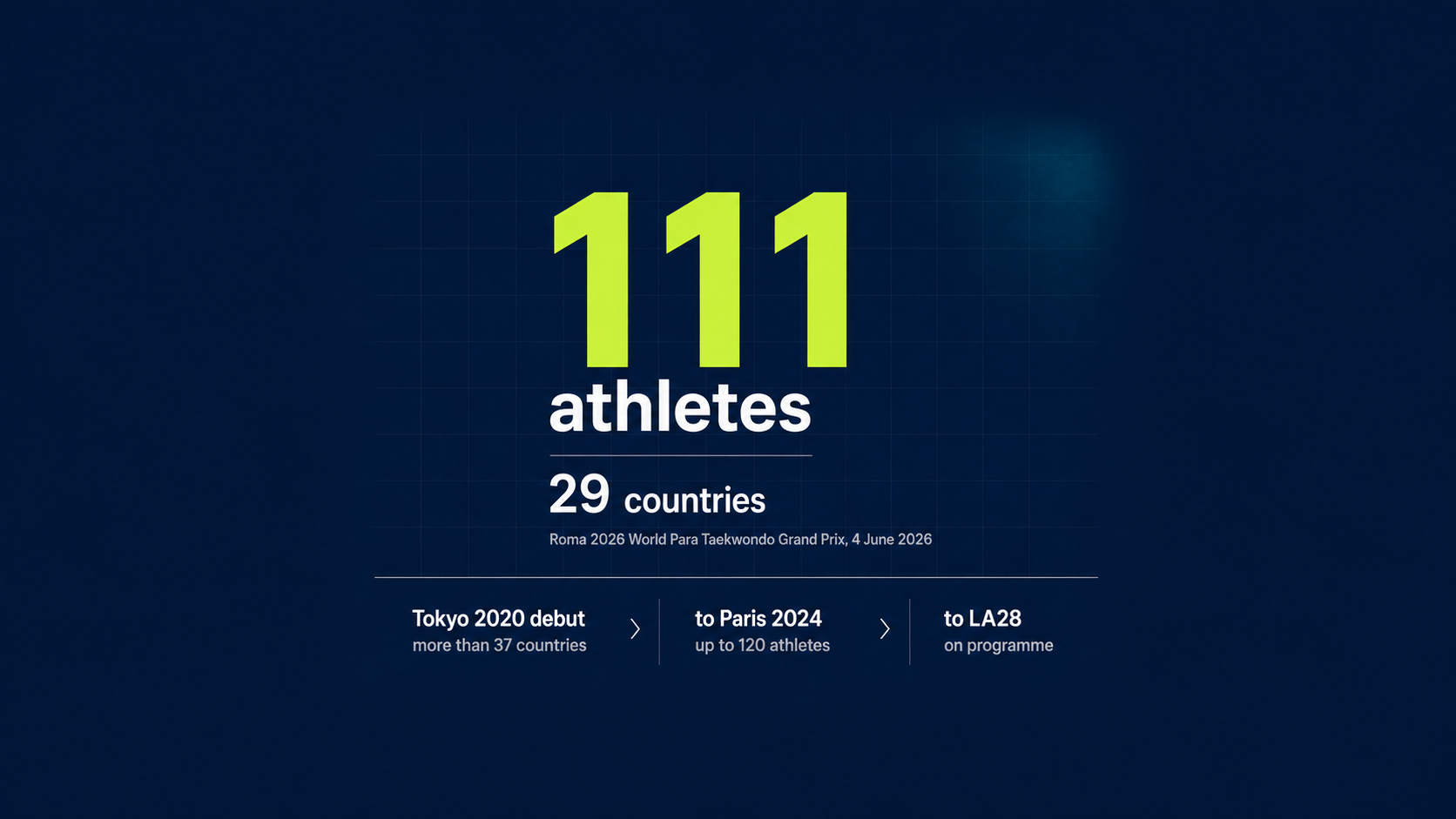
The Roma 2026 World Para Taekwondo Grand Prix drew 111 athletes from 29 countries to the Foro Italico on 4 June 2026, opening a Grand Prix Series weekend staged by World Taekwondo. The Para event ran one day ahead of the main World Taekwondo Grand Prix, which fielded 255 competitors from 51 nations across 5 to 7 June. For a Paralympic discipline that debuted only at Tokyo 2020, the breadth of the Para field is the more interesting figure than any single result.
How a young discipline became a Paralympic sport
Para taekwondo is the adaptive form of the sport, contested one-on-one on an octagonal mat in weight classes, with athletes classified by impairment type and degree. The Grand Prix is run in the K44 classification, for athletes with upper-limb impairment in one or both arms; "K" denotes kyorugi, the sparring format. World Taekwondo, the sport's governing body, runs the Para programme and stages the World Para Taekwondo Grand Prix series within its competition framework.
The discipline took shape after Para taekwondo was developed in 2006, and entered the Paralympic programme at Tokyo 2020, where it became the second full-contact sport on the Games schedule. That debut fielded 70 athletes from more than 37 countries and regions across 24 medals, with athletes from 17 nations reaching the podium. The trajectory since has been one of widening participation rather than concentration among a few dominant systems.
What the participation numbers actually show
The Rome figure should be read as a participation signal, not a competitive verdict. A 29-country field at a single Grand Prix, in a discipline barely two Paralympic cycles old, is a useful signal of how widely the sport is distributing across national systems.
Voice Sport editorial read — the participation-breadth pathway. Three reference points along the Paralympic pathway frame that reading. At Tokyo 2020, the debut field comprised more than 37 countries and regions, and every continent saw at least one athlete standing on the podium. At Paris 2024, the athlete quota was increased to up to 120 across ten medal events (five for men and five for women, twelve athletes per category). And the Refugee Paralympic Team won its first-ever Paralympic medal in any sport through Para taekwondo. Read across those three cycle markers and now the Rome Grand Prix, the discipline can be read as an access point for a broad range of national systems and athlete profiles, though a direct comparison with longer-established Paralympic sports would require sport-by-sport data. This is a Voice Sport reading of the pathway data, not a claim carried by any single source; the individual figures are sourced to the International Paralympic Committee and LA28, while the cross-cycle breadth pattern is the editorial synthesis.
The 29-country Grand Prix entry list in Rome sits inside that pattern. Grand Prix events are not the Paralympic Games; they are the qualification-tier and ranking circuit beneath them. A broad Grand Prix field is a useful signal that the breadth seen at Games-time may be supported by an active competition base, rather than assembled only once every four years, though it does not by itself prove national-system depth.
Who competed, and why the field composition matters
The Rome Para field carried recognisable competitive depth. Per The Korea Times preview of 2 June, the draw included six Paris 2024 Paralympic gold medallists, among them Israel's Asaf Yasur and Brazil's Ana Carolina Silva de Moura. Morocco's Ayoub Adouich, the 2025 Para Taekwondo Male Athlete of the Year, was also scheduled to compete, as was Zakia Khudadadi, the Paris 2024 Refugee Paralympic Team bronze medallist.
That composition is itself the social-impact reading. A single Grand Prix list spanning Israel, Brazil, Morocco and a former Refugee Team medallist is a map of how the discipline has distributed beyond any single region's base. For European federations, the relevant observation is that the European presence in Para taekwondo sits within a genuinely global field rather than a continentally concentrated one — a different competitive environment from sports where European systems set the early standard.
The main World Taekwondo Grand Prix, running the following three days, drew its own globally distributed field of 255 from 51 nations, with the Taekwondo Refugee Team also entered. Per The Korea Times, Belgium's Sarah Chaâri, the 2025 Female Athlete of the Year and reigning world champion, and Hungary's Olympic champion Viviana Márton featured among the Olympic-discipline entries. The Para and Olympic disciplines share a venue, a governing body and a Grand Prix Series structure, which is part of what gives the Para circuit its visibility.
What the Rome field means for European inclusion strategy
For European sport organisations building inclusion and Para-development strategy toward Los Angeles 2028 — where Para taekwondo is confirmed on the Paralympic programme — the Rome Grand Prix is a usable data point rather than a headline. The operative question is conversion: which of the 29 national systems that entered athletes in Rome are running sustained domestic pathways, and which appear at Grand Prix level intermittently.
That distinction matters because participation breadth at a single event can mask uneven depth beneath it. A nation entering one athlete in Rome and a nation with a structured Para development programme both appear identically in a 29-country count. The breadth figure is encouraging at the level of the discipline; it does not by itself describe the health of any one national system. European federations weighing where to direct Para-development resource, or where to seek partners for cross-border athlete pathways, gain more from the composition of the field than from its headline size.
It is also worth noting what the figure is not. A single-day Grand Prix participation count is not a measure of audience, commercial value or media reach for Para taekwondo; on a Voice Sport reading, those indicators are likely to trail the Olympic discipline's, though the available sources carry no comparative data to size that gap. The case for the sport's growth rests on the participation and pathway data, not on commercial indicators that the available evidence does not yet support.
What is uncertain
The open question across the next two years is whether the participation breadth visible at Tokyo 2020, Paris 2024 and now the Rome Grand Prix holds or widens into the Los Angeles 2028 cycle. Paralympic-sport programmes are periodically reviewed, and qualification structures evolve between cycles; a broad Grand Prix field in 2026 is a positive signal but not a guarantee of the same breadth at Games-time in 2028.
Equally unresolved is the depth-versus-breadth question at national level. The Rome figure confirms that 29 systems can field Grand Prix athletes; it does not confirm how many run the year-round development structures that turn a one-off entry into a durable pathway. That is the data European federations and national Paralympic bodies would need to track directly, and it is not visible in a single event's entry list.
The reasonable read of 4 June is that Para taekwondo continues to distribute widely as it approaches its third Paralympic cycle, and that the Grand Prix circuit is doing the development-tier work that a maturing Paralympic discipline requires. For European federations and national Paralympic bodies setting Para-development priorities toward LA28, the operative watch-item is the national-system depth behind the breadth, not the breadth alone.
Sources
- MASTKD, "Rome 2026 Grand Prix Series opens with Olympic, Paralympic and institutional spotlight" (mastkd.com/2026/06/rome-2026-grand-prix-series-opens-with-olympic-paralympic-and-institutional-spotlight/).
- MASTKD, "Rising stars shine on dramatic day two at Roma 2026 World Taekwondo Grand Prix" (mastkd.com/2026/06/rising-stars-shine-on-dramatic-day-two-at-roma-2026-world-taekwondo-grand-prix/).
- The Korea Times, "Rome welcomes taekwondo elite for Grand Prix" (koreatimes.co.kr/sports/20260602/rome-welcomes-taekwondo-elite-for-grand-prix).
- International Paralympic Committee, "Introduction to Para taekwondo at Paris 2024" (paralympic.org/feature/paris-2024-introduction-para-taekwondo).
- LA28, "Para Taekwondo — Games plan" (la28.org/en/games-plan/paralympics/para-taekwondo.html).