The framing that circulated when Michele Kang's June 2026 transaction closed was precise in some respects and misleading in others. Precise: Kang took control of Eagle Football Group S.A., the listed parent company of Olympique Lyonnais, ending John Textor's ownership. Misleading: the transaction was widely described as completing or creating Kynisca's women's football multi-club network.
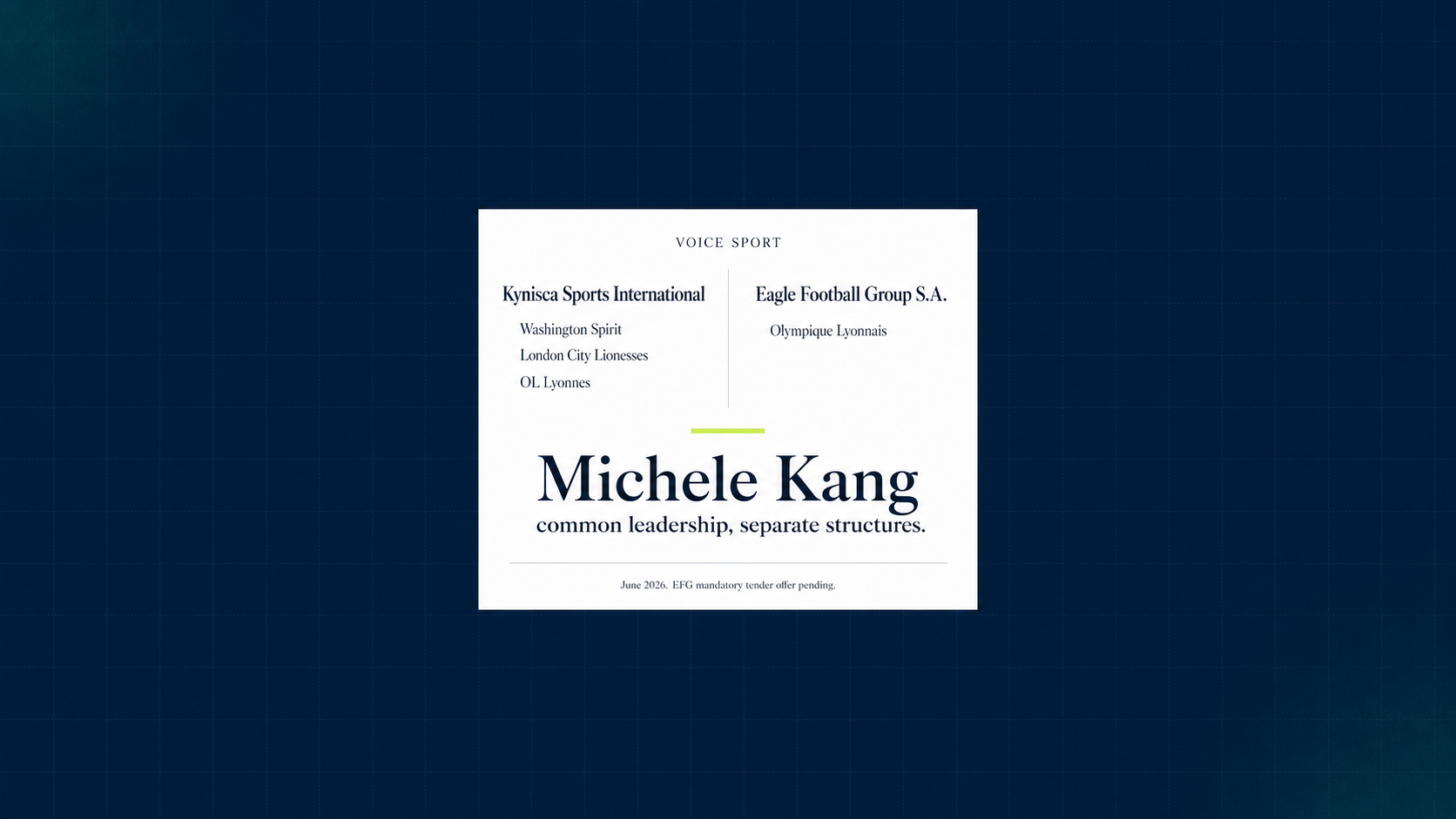
Kynisca was not created or completed in June 2026. Washington Spirit, OL Lyonnes, and London City Lionesses were operating together under the Kynisca Sports International structure from July 2024, when Kynisca was formally launched. OL Lyonnes — the women's club — was already part of that structure before the Eagle Football Group deal. The June 2026 transaction is something structurally different. Understanding what it is, and what it is not, is the precondition for any useful analysis of it.
---
What the June 2026 Transaction Actually Is
Olympe Bidco acquired Eagle Bidco's approximately 87.78 percent stake in Eagle Football Group S.A. for $30 million. Eagle Football Group is a listed company; its principal asset is Olympique Lyonnais, the men's football club. Separately, Kang committed to provide up to €71 million in new funding to the group over two seasons — approximately €75 million including transaction costs. These are two distinct figures: a block acquisition price and a forward funding commitment.
The transaction closed after French football's financial regulator, the DNCG, confirmed that Olympique Lyonnais would retain its Ligue 1 status for the 2026–27 season. That confirmation was the deal's closing condition. It resolved the uncertainty over the club's participation in top-flight competition. It should not be described as a complete resolution of Eagle Football Group's wider financial constraints; the DNCG's role is specifically to assess club financial health for the purpose of competition licensing, not to certify the solvency or financial health of the broader corporate structure.
A mandatory offer for the remaining listed EFG shares is part of the post-closing process, subject to the relevant Autorité des marchés financiers procedure. The controlling block acquisition has closed; the full process has not.
The precision matters in any context where the asset being described is the club rather than the parent company. What Kang acquired was approximately 87.78 percent of Eagle Football Group S.A., not 87.78 percent of Olympique Lyonnais directly.
---
What Kynisca Already Was
To understand what June 2026 did and did not change for Kang's women's football portfolio, the structure that existed before the transaction needs to be clear.
Kynisca Sports International was launched on 27 July 2024. At launch, it brought together Washington Spirit (NWSL), OL Lyonnes (French Division 1 Féminine), and London City Lionesses (WSL) as the first global, female-owned multi-club organisation dedicated to women's football. Kynisca's positioning at launch — "first global, female-owned multi-club organisation" — is a 2024 claim. It describes the structure created in 2024, not a structure created or completed by the 2026 EFG transaction.
OL Lyonnes was part of Kynisca from that point. The women's club, which competes in the UEFA Women's Champions League, had been acquired by Kang earlier and was a founding element of the Kynisca structure. The three Kynisca clubs provide exposure across three of the most developed women's football markets — the United States, England, and France — with differentiated regulatory and broadcast environments. Kynisca has indicated its intention to add further clubs; the network is positioned as a growing structure, not one declared complete.
OL Lyonnes and Olympique Lyonnais are distinct entities. OL Lyonnes is the women's club and a Kynisca member. Olympique Lyonnais is the men's club whose listed parent, Eagle Football Group, Kang acquired in June 2026. Using "Lyon" interchangeably for both introduces a category error that runs through much of the transaction reporting.
---
The Governance Complexity the Transaction Introduced
What the EFG transaction introduced — and what the transaction-completion framing largely missed — is a structural governance complexity.
Kang now controls two distinct football architectures under common ownership. On one side: Kynisca Sports International, with an explicit mandate focused on women's football and a stated operational and financial independence from men's football operations. On the other: Eagle Football Group S.A., the listed parent of Olympique Lyonnais' men's operation, which carries different regulatory obligations, shareholder obligations, and financial constraints than a private women's football holding structure.
Kang has stated publicly that the Kynisca structure will remain operationally and financially distinct from EFG, and that the men's team will be run separately. That is the stated policy. Whether it is structurally durable under conditions of financial pressure is the operational question the next 12 to 18 months will begin to answer.
Eagle Football Group was financially distressed. The men's club carried a debt burden that Textor's multi-club holding had accumulated, and the DNCG's prior concerns about Lyon's financial position were the source of the participation uncertainty the closing condition resolved. Kang's forward funding commitment of up to €71 million over two seasons is directed at stabilising and developing that structure. The terms of that funding — how it is structured, how it is accounted for within EFG, and how it interacts with Kynisca's own capital allocation — determine whether the two structures are genuinely ring-fenced.
Where that capital flows, how it is accounted for across the two structures, and whether Kynisca's women's clubs are exposed to EFG's financial obligations or shielded from them are governance questions the transaction raised but did not resolve. The mandatory tender offer for remaining EFG shares adds a further procedural layer to what full control means in practice.
---
Performance Attribution
Men's Olympique Lyonnais finished fourth in the 2025–26 Ligue 1 season and qualified for Champions League qualifying rounds. This result coincided with the period of Kang's involvement in the club's leadership. Whether that result reflects the effect of the leadership transition, the playing squad assembled before her involvement, or the stabilisation of the financial uncertainty that had previously burdened the club's operations is not established in public reporting. The result is a data point. Attributing it directly to Kang's leadership is not supportable on the basis of publicly available evidence.
OL Lyonnes is a separate sporting entity with a separate competitive record. The men's Ligue 1 result belongs to Olympique Lyonnais. Washington Spirit does not compete in the UEFA Champions League. The three Kynisca clubs provide access to the NWSL, WSL, and French Division 1 Féminine, with OL Lyonnes the Kynisca member competing in the UEFA Women's Champions League.
---
The Analytical Frame That Holds
Stripped of the framing errors, the story is still significant — it is just a different story.
Kynisca Sports International is a real and structurally novel organisation. Built from 2022, formally launched in July 2024, it brings together three of the most commercially relevant women's football leagues under a single operational structure. The logic behind it — shared infrastructure, cross-league development pathways, consolidated commercial representation — addresses resource gaps that individual women's clubs cannot address at scale. That logic is genuine.
The June 2026 EFG transaction added a new and complicating dimension. Kang now controls both a women's-football-specific multi-club network and the listed parent of a major men's football operation. The stated intention is to keep them separate. The financial pressure that made the EFG acquisition possible is the same pressure that will test whether the separation can be maintained.
For European sport governance audiences, the questions that are worth tracking over the next 12 to 18 months are concrete. How does Kynisca document and enforce the operational separation from EFG's men's operations? Does the €71 million forward funding commitment to EFG affect Kynisca's capital available for women's football development? How does the mandatory tender process resolve, and what shareholder obligations does full EFG control carry? And does a comparable second network emerge in women's football — either because the Kynisca model demonstrates replicable value, or because the complexity of the dual-architecture structure produces visible strains?
The significance is not that Kynisca has gained a third club — it already had one in Lyon. It is that Kang now sits across two distinct football architectures, and the governance of that dual position is the story the 2026 transaction actually created.
---
Sources
Primary sources: - Reuters, "Kang moves to take control of Olympique Lyonnais owner EFG for $30 million," 23 June 2026. reuters.com - Actus News / Eagle Football Group press release, "Signing of the SPA between Eagle Bidco and Olympe Bidco," 23 June 2026. actusnews.com - Washington Spirit, "Michele Kang Announces Launch of Kynisca Sports International Ltd," 27 July 2024. washingtonspirit.com - Kynisca, "Olympique Lyonnes Féminin Unveils Bold New Brand and Vision." kynisca.com
Supporting reporting: - France24, "American businesswoman Michele Kang buys French club Lyon," 26 June 2026. - Inc., "Billionaire Michele Kang Just Bought a Soccer Giant for a 'Bargain'—but Can She Rescue It?" inc.com - Sports Mole, Ligue 1 2025–26 final standings.
Regulatory context: DNCG (Direction Nationale du Contrôle de Gestion) — French football financial regulator. AMF (Autorité des marchés financiers) — French financial markets regulator, mandatory tender offer procedures.