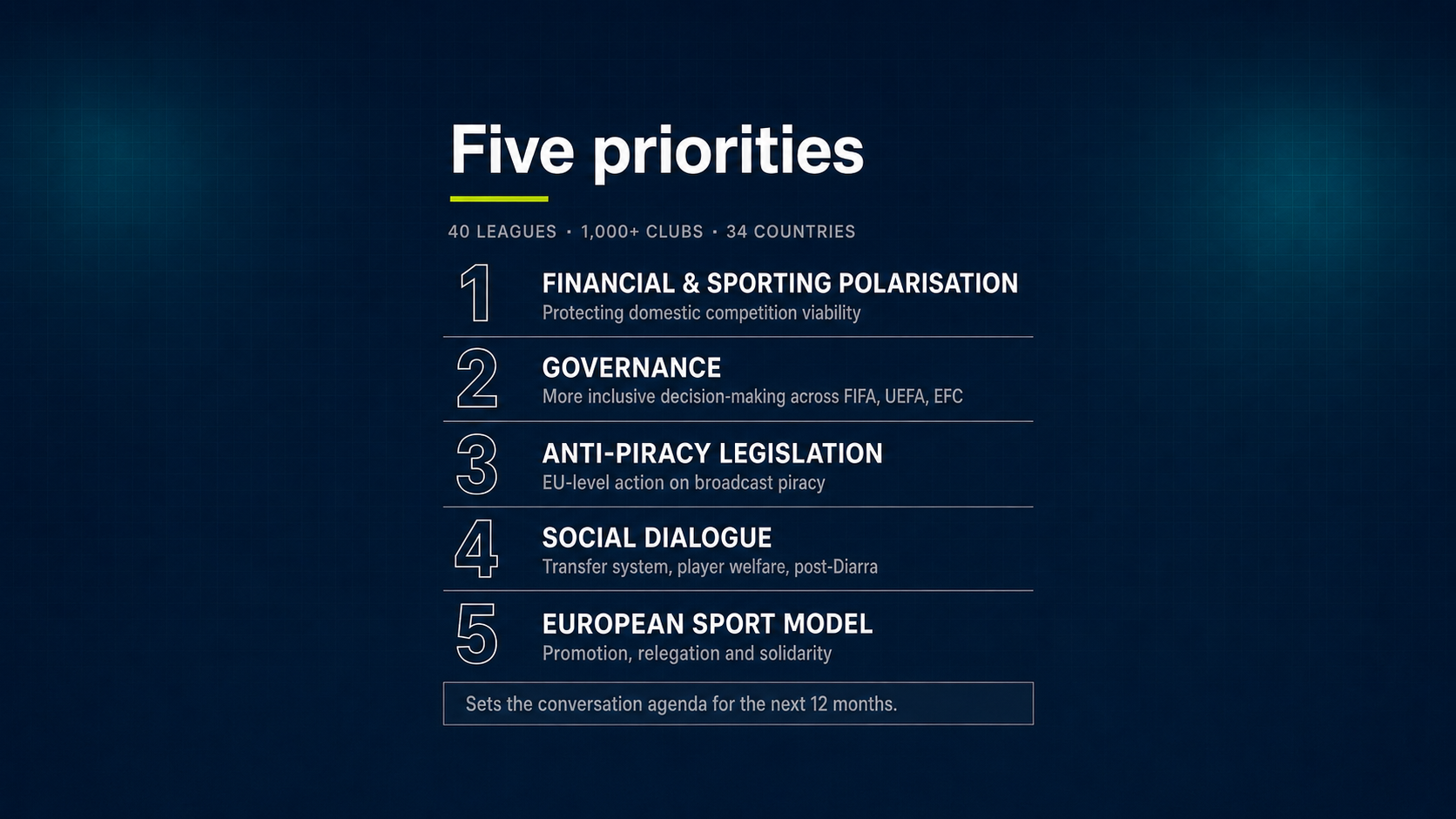
The European Leagues organisation — representing 40 professional leagues, more than 1,000 clubs and 34 countries — endorsed its 2026-27 Strategic Priorities at its 52nd General Assembly in Sofia on 12 March 2026. The document sets European Leagues' institutional agenda for the next UEFA governance cycle and for EU sport policy engagement. 35 leagues were represented at the General Assembly, where the strategy was endorsed unanimously.
The official strategy is structured around five core pillars: financial and sporting polarisation, governance, anti-piracy legislation, social dialogue and the European Sport Model. Each intersects with regulatory and governance processes that are either active or anticipated in the 2026-27 period.
Polarisation and Competitive Balance: The Structural Challenge
Resource concentration in European club football has intensified across the past decade. European Leagues' first pillar frames this as a compound problem — financial polarisation and sporting polarisation are treated as connected outcomes of how European competition structures distribute revenue.
The Squad Cost Rule under UEFA's Club Licensing and Financial Sustainability Regulations — one of three mechanisms alongside the Football Earnings Rule and the No Overdue Payables Rule — reached its permanent ceiling of 70 per cent from the 2025-26 season. The rule limits squad costs (wages, transfer amortisation and agent fees) to 70 per cent of club revenue, phased in progressively from 90 per cent in 2023-24. European Leagues broadly supports cost-control mechanisms of this kind; its competitive balance position is that cost control is a necessary but insufficient condition, and that revenue distribution from UEFA club competitions to domestic leagues remains the structurally decisive variable.
The UEFA–EFC joint venture UC3 — managing the 2027–31 UEFA club competition commercial and media-rights cycle — is the commercial structure European Leagues will be watching most closely for distribution decisions.
Governance: International Match Calendar and Decision-Making Inclusion
The international match calendar has been a consistent European Leagues priority. Per the organisation's own framing, European Leagues argues that IMC decision-making and the expansion of international competitions are undermining domestic football and require more inclusive governance across FIFA, UEFA and EFC structures.
The strategy points to continued dialogue on the post-2030 IMC as a vehicle for advancing European Leagues' position in these governance conversations. The organisation has also brought competition-law complaints before EU authorities related to the governance of international club competition; this legal track runs in parallel with the policy agenda.
Anti-Piracy Legislation: The Revenue Protection Priority
Anti-piracy legislation is a formal pillar of the 2026-27 strategy — a position European Leagues has held across multiple strategy cycles and which has gained institutional traction as EU digital policy develops.
European Leagues has consistently argued that broadcast piracy represents a direct financial threat to the domestic competition ecosystem. The 2026-27 priorities position the organisation to push for accelerated EU-level legislative action, including real-time blocking mechanisms, as part of the Commission's digital enforcement agenda.
Social Dialogue: Transfer System, Labour Relations and Player Welfare
Social Dialogue is the fourth official pillar, covering the cross-stakeholder agenda with FIFPRO and EU institutions. The central topics include the international transfer system, labour relations frameworks, player health and safety, and the implications of the Court of Justice of the EU Diarra ruling for player mobility and contract regulation.
The Diarra ruling — which found certain FIFA transfer regulations incompatible with EU law — has opened a regulatory question that European Leagues, FIFPRO, FIFA and UEFA are each positioning to influence. European Leagues' Social Dialogue pillar is partly a response to the governance space the ruling has created.
European Sport Model: Protecting Structural Features in EU Policy
The fifth pillar addresses the specific institutional architecture of European sport: promotion and relegation, solidarity payments, the role of national federations, and the distinction between the European model and closed-league commercial structures.
European Leagues' position is that these features require explicit protection within EU policy — both in ongoing Commission sport strategy work and in any legislative or regulatory instruments that touch the sector. The European Sport Model pillar is as much a lobbying position directed at the Commission and the Council of Europe as it is an internal governance priority.
What This Means for the Football Ecosystem
European Leagues' 2026-27 Strategic Priorities are a lobbying and policy agenda, not regulatory decisions. Their significance lies in which governance conversations they will activate over the next 12 months.
For sport-tech companies serving European leagues: The polarisation and competitive balance priorities point toward demand for financial analytics, wage structure modelling and performance data that helps lower-resource clubs remain competitive.
For EU sport policy professionals: The anti-piracy, Social Dialogue and European Sport Model positions engage directly with the Commission's forthcoming EU Sport Strategy and with the Council of Europe EPAS agenda on good governance.
For national federations and domestic leagues: The document is the collective expression of what 40 leagues across 34 countries believe their long-term structural interests require — heading into a governance cycle in which UEFA, EFC, FIFPRO and the Commission are all active parties.
Sources
- European Leagues — "European Leagues members endorse 2026-27 Strategic Priorities", 12 March 2026 — [europeanleagues.com](https://europeanleagues.com/european-leagues-members-endorse-2026-27-strategic-priorities-aimed-at-furthering-the-development-of-football-2/)
- UEFA — Club Licensing and Financial Sustainability Regulations, Article 94 Squad Cost Rule — [documents.uefa.com](https://documents.uefa.com/r/UEFA-Club-Licensing-and-Financial-Sustainability-Regulations-2025/Article-94-Squad-cost-rule-Online)
- UC3 — UEFA–EFC joint venture, club competition commercial rights — [uc3.com](https://www.uc3.com/)
- European Commission — Article 165 TFEU, EU sport policy — [ec.europa.eu/sport](https://ec.europa.eu/sport)